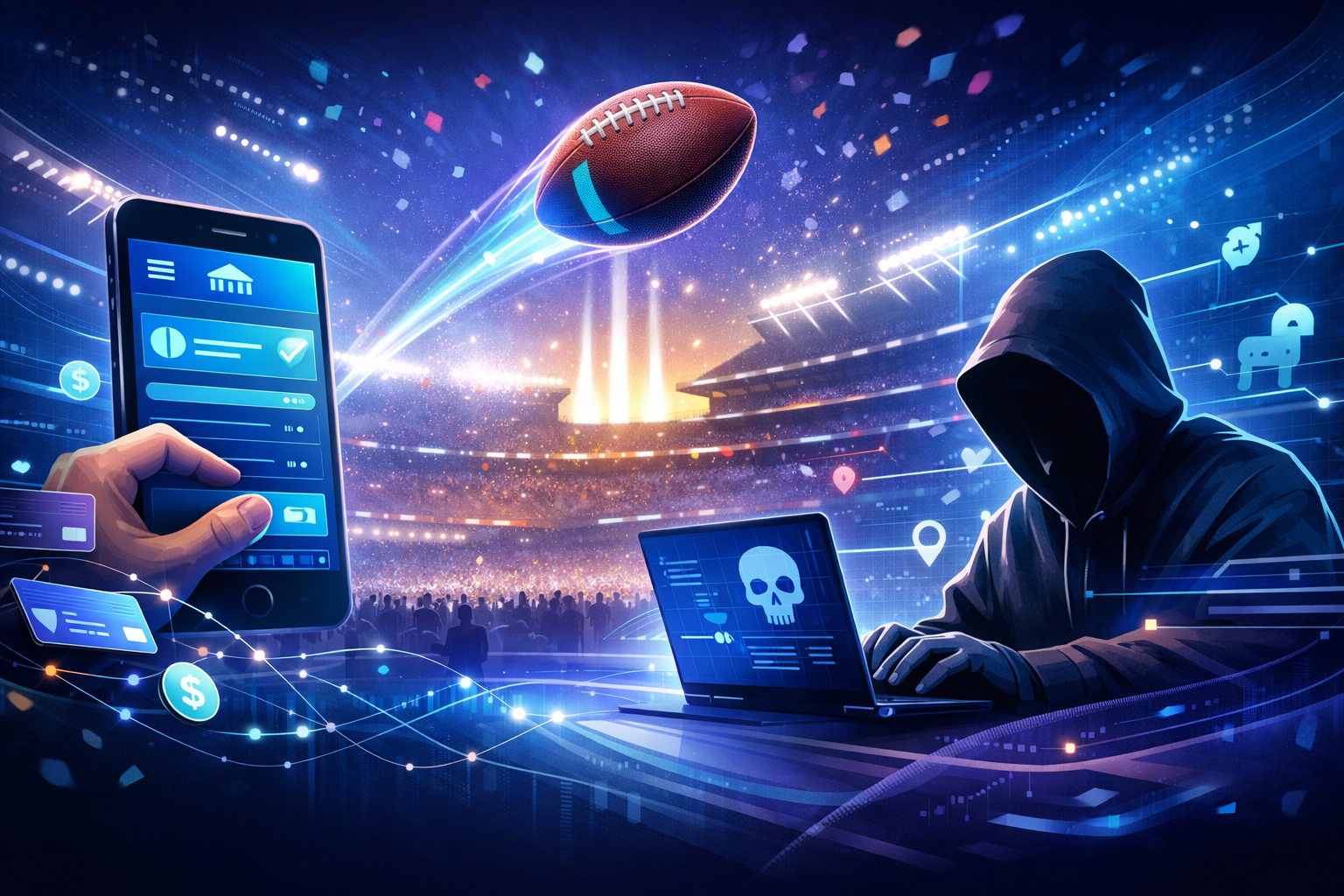
Super Bowl LIX took place on Feb. 9, 2025. An estimated 127.7 million people in the U.S. watched the game, the most in the 59-year history of the contest. While Americans tuned in and ate snacks and drank beer and hosted parties, it seems they spent less time banking.
We analyzed data from seven U.S. retail banks deploying BioCatch solutions, examining digital banking activity during the afternoon and evening on both the Sunday of the game and the following Sunday. The traffic analyzed included all sessions with a successful login, regardless of whether those sessions resulted in a successful payment.
The government made a strong start on this important program but failed to follow through at the final stage. This article analyzes what went wrong and offers ideas to rectify the problem.
Key Highlights
- Less banking during gametime: We saw sessions decrease by as much as 22% during the game.
- Business as usual resumes quickly: Banking activity resumes almost immediately after the final whistle (even surpassing that of a normal Sunday), with a 12% spike in activity observed after the Eagles lifted the Lombardi trophy.
- Activity plummets after halftime show: The commercial break into the start of the second half accounts for the greatest deviation in banking activity between gameday and the following Sunday.
- Fraud activity remains constant: While consumers spent significantly less time banking during game time, it appears the habits of fraudsters (who are often located outside of the U.S.) aren’t impacted by the game.
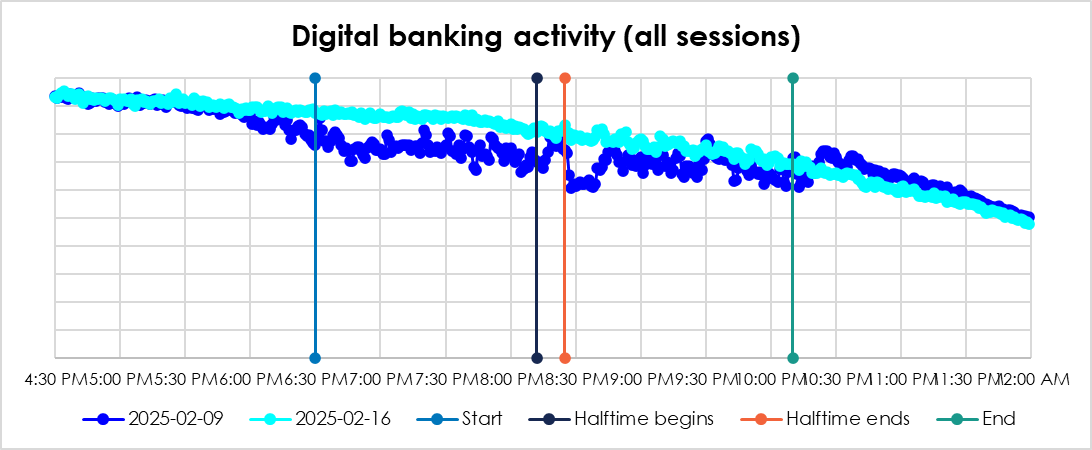
Graph analysis (all sessions)
-
Activity plummets after halftime show: The commercial break into the start of the second half accounts for the greatest deviation in banking activity between gameday and the following Sunday.
-
The traffic for the Sunday after the Super Bowl shows a gradual decline in session volume throughout the afternoon and evening. This is standard activity seen across many financial institutions.
-
The traffic on the day of the Super Bowl breaks this trend, with shifts in volumes that correlate to key event timelines, some of which are marked on the graph.
-
The biggest shift in traffic volumes occurs immediately after the halftime show ends, suggesting viewers put down their digital banking devices and lock back into the game.
-
As the game ends, traffic increases and exceeds volumes seen the week after. This suggests users may be executing activity that had built up during the almost four-hour break.
-
After the game is over, traffic patterns return to normal, with the line resembling a similar shape to that of the following Sunday.
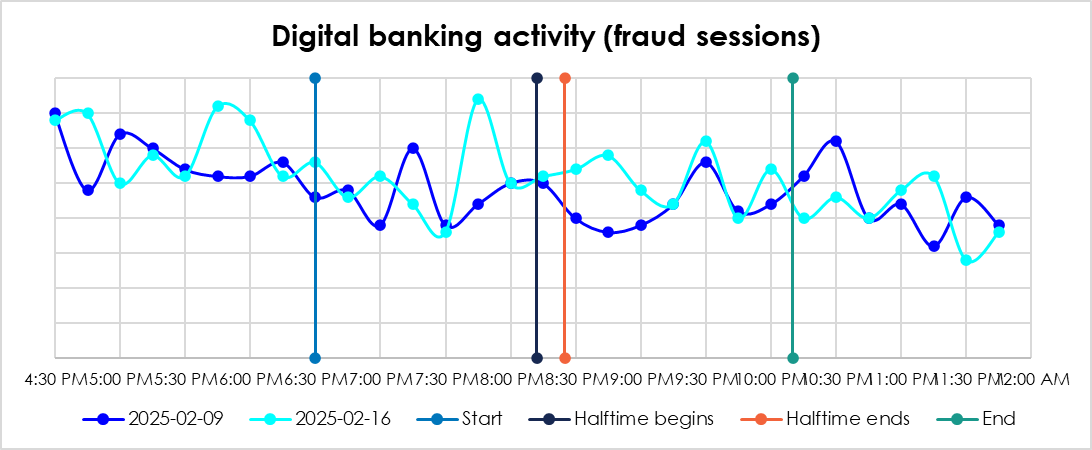
Graph analysis (fraud sessions)
-
Fraudulent session volume is less consistent than general traffic, which is partly due to lower volumes leading to more volatility.
-
There are no obvious patterns in the lines that would suggest a change in fraudster behavior as a result of the Super Bowl. That said, we do see the lowest volumes of fraud immediately after the halftime show — similar to the general traffic trends.
Detailed analysis of general activity
In the two hours before the game kicks off, we see traffic nearly identical to traffic on the Sunday following. At 6:01 p.m., traffic starts to decrease at a steady rate of 6-7% until 6:25 p.m., at which point it drops by 12%. This coincides with the pre-kickoff events, including the coin toss. During the first half, digital banking sessions drop by an average of 13%.
During the halftime show, we see traffic increase slightly. Immediately after the show ends, we see a sharp drop in traffic once again, reaching values 22% lower for the following 15 minutes.
The second half sees a drop in traffic compared to the following Sunday — although the reduction rate is lower, with values averaging 8% throughout. There is one exception, however: At 9:30 p.m., we see a spike in traffic that is not only anomalous for the day but also represents up to 6% more traffic than the following Sunday. This is perhaps due to the state of the game. At the end of the third quarter, the Eagles led, 34-6, potentially leading some fans to stop paying as close attention.
After this anomaly, and as the game enters its final phase, we see traffic continue to follow the same pattern as throughout the rest of the game — although the decrease in traffic compared to the following Sunday is less pronounced, standing between 5 and 8%.
The game officially ends at 10:10 p.m. We see a spike once again, with traffic during this time period 4% higher than during the same time period the following week. This doesn’t last long though, and minutes later, we see an 8% drop for several minutes (perhaps due to viewership of the trophy ceremony).
After the trophy is lifted, we see another surge in traffic, which is 12% higher than the same times on the following Sunday. This higher rate of traffic lasts for approximately 25 minutes and then begins to taper. That said, traffic is still higher, at rates between 4 and 9%.
Analysis of user-platform interaction
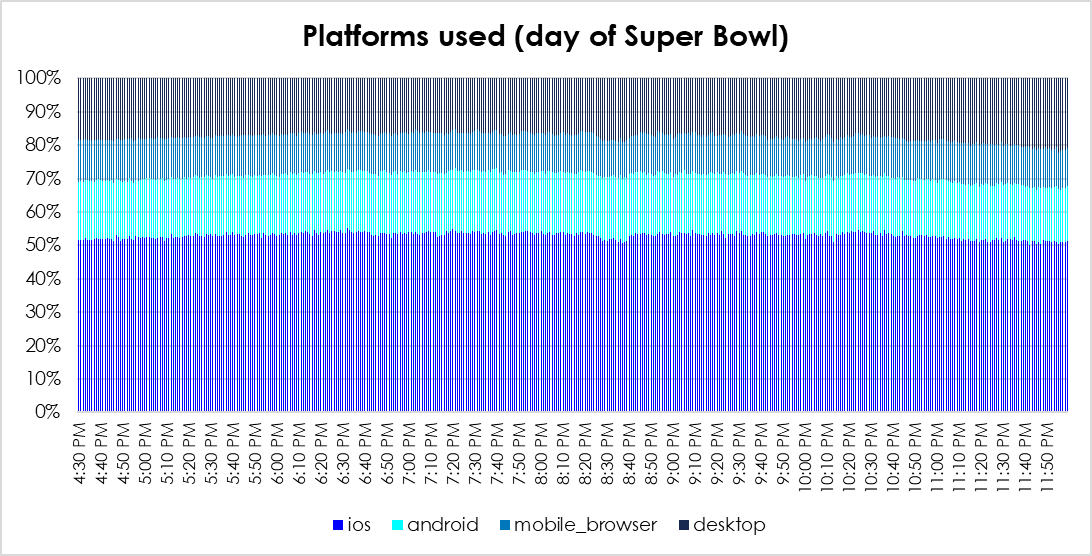
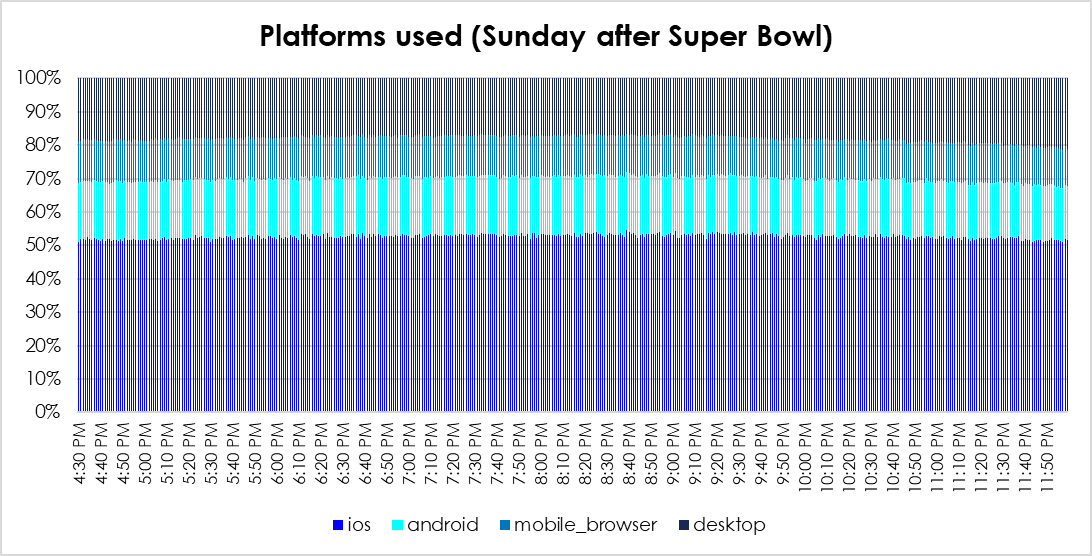
We see the majority of digital banking traffic (80-85%) during the Super Bowl originating from mobile devices, of which iOS devices represent more than 50% of all digital banking traffic. These numbers are consistent with the following Sunday, with similar curves seen on both graphs below.
During the halftime show and its decline in total digital banking sessions, however, we do see an increase in the proportion of traffic originating from desktop devices. This blip in the trend lasts the same as the reduction in traffic seen. This combination of factors would suggest mobile channels account for the majority of the drop in users during this time period. This itself would likely be caused by consumers using mobile devices for other activities, like viewing reactions to the halftime show on social media.
Less banking, normal fraud
We observe an apparent change in how people interact with digital banking platforms during the Super Bowl. On average, it appears one in eight people (12%) stopped conducting their normal Sunday banking activity. During key moments of the broadcast, this climbed to nearly one in four people (22%).
Fraudsters don’t follow the same pattern. Fraud traffic is more or less consistent, suggesting that, for fraudsters, the Super Bowl just means criminal business as usual.
-
Key takeaways:
- Super Bowl viewership significantly reduced digital banking activity: Banking sessions dropped by as much as 22% during key moments of the game.
- Banking activity rebounded immediately after the game: Traffic surged 12% after the Eagles lifted the Lombardi Trophy.
- The halftime show drove the sharpest decline in banking usage: The largest drop in activity occurred immediately after halftime ended.
- Fraud activity remained largely unchanged during the Super Bowl: Fraudsters appeared unaffected by the event, maintaining relatively consistent activity levels.
- Mobile devices dominated Super Bowl banking traffic: Roughly 80–85% of sessions originated from mobile devices during the game.
- Consumers paused banking, but fraudsters didn’t: While many users disengaged during the broadcast, fraud activity continued as business as usual.
Resources:
- Blog: Fraudsters like sports too: Fraud and digital banking sessions declined during Euros and Copa matches
- Blog: Will fraudsters win big at UEFA Euro 2024? How football tournaments can impact banking habits and fraud
- Report: 2025 Digital Banking Fraud Trends in the U.S.
- Fox News: Super Bowl scams surge in February and target your data