
Precision measures the proportion of correct classifications made by a machine learning model. In this series of blogs, we explore why precision is essential in combating fraud and financial crime.
Account opening serves as both the first line of defense for financial institutions and the earliest point of exploitation for fraudsters. Errors at this stage can lead to both increased fraud and unnecessary operational expenses (OPEX).
Financial institutions are increasingly adopting a digital-first approach to onboarding, with most customers beginning their journeys online. New account applications are typically either immediately accepted or outright rejected.
Without precision, genuine customers may become frustrated with this process, while criminals undoubtedly will exploit its weaknesses. Achieving both a positive customer experience and effective risk mitigation requires precision.
For years, financial institutions have relied on rule-based, static controls such as Know Your Customer (KYC) checks, device fingerprinting, and document checks to reduce onboarding risk.
While these controls remain important, most were designed for a time when threat actors lacked the technology for scalable, automated attacks. In the age of agentic AI, the pace of attack evolution is accelerating.
As a result, account opening has become the frontline in an increasingly asymmetrical battle between banks and criminals.
A detection rate of 60% to 65% often results in significant friction. If this creates a 10-to-one ratio of genuine to fraudulent applicants, 10 legitimate customers will experience maybe unnecessary friction for every bad application the bank denies.
Manual reviews increase OPEX and negatively impact a customer's initial experience. Those 10 customers need not be considered collateral damage. Banks don’t have to accept this outcome.
Behavior provides a path to precision
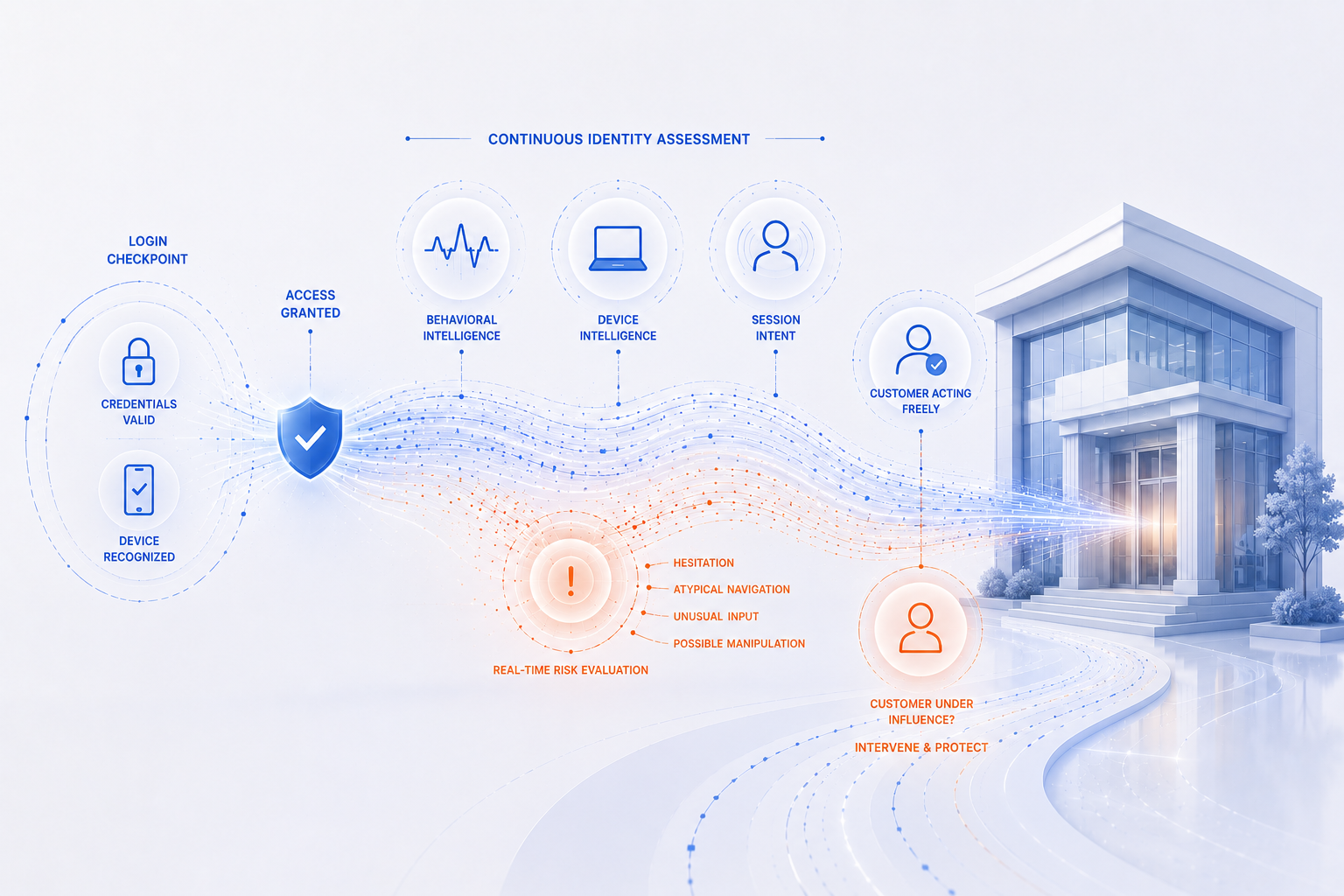
Behavioral intelligence uses applicant behavior to identify both human and AI-driven bad actors. Typing rhythm, hesitations, mouse dynamics, and familiarity with the application process are not superficial signals. These traits are inherently human, difficult to fake, and extremely challenging for AI agents to replicate.
Criminals often approach the account opening journey equipped with a mix of breached, genuine, fake, or increasingly synthetic application data. They may submit real or counterfeit documents that pass remote onboarding checks. Liveness checks can also fail, as criminals increasingly use video that appears to match the provided documents.
Behavioral intelligence enhances precision by continuously updating risk profiles. It distinguishes between:
- Human versus non-human interaction
- Familiarity with personal data and your application form
- Natural versus scripted form filling
- Cognitive confidence versus uncertainty
This approach complements static controls by identifying risks that might otherwise go undetected.
In a future blog, we will examine how behavior helps identify money mules. Precision in account opening and mule detection allows financial institutions to reduce friction without increasing risk.
Increased detection, with precision, changes everything
A 5% increase in detection may seem modest, but for a bank, improving from a 65% to 70% detection rate can be transformational.
- Fewer fraudulent accounts mean each blocked account disrupts an entire fraud chain. Without mule accounts, opportunities for money laundering are eliminated.
- OPEX decreases, and outcomes for genuine applicants improve. Instead of flagging 10 legitimate customers for every fraudulent one, you move toward a three-to-one ratio, enabling review teams to focus on real risks rather than false positives.
- Genuine customers benefit from a smoother onboarding experience, reducing the risk of abandonment due to additional steps or delays from manual reviews.
- Improved compliance and early prevention strengthen your response to financial crime without compromising business fundamentals.
The benefits of precision compound over time.
This is especially true for managing OPEX. Instead of expanding fraud teams to meet increased review demand, your institution can scale customer recruitment cost-effectively.
Precision also reduces the number of fraud events that a bad account can enable. If undetected, such accounts may result in multiple compliance incidents.
Precision at account opening prevents downstream risk and controls OPEX growth, while still allowing for customer base expansion.
Theory in practice
Precisely applied friction isn’t just some theoretical experiment. It already performs splendidly against all account opening threats.
For proof, we need look no further than a top five Canadian bank, which experienced a fourfold increase in application fraud during the pandemic. In response, it leveraged behavioral intelligence to reduce risk while maintaining customer experience and supporting growth.
Applying behavioral intelligence to the bank’s account opening process saved it $7.7 million in projected losses, while reducing manual reviews by 67%, resulting in $663,000 in estimated operational savings.
Conclusion: Precision enables profitable growth
Account opening is no longer just about new-customer onboarding. It is now a critical component of every financial institution’s risk management strategy.
Precision detection using behavior transforms digital account opening from a vulnerable process into one that actively reduces friction, lowers OPEX, and supports growth without increasing risk.
For further reading on the benefits of precisely applied friction, click here.
no longer: What just happened? It’s: What is about to happen, and why?
—