
Precision measures the proportion of correct classifications made by a machine learning model. In this series of blogs, we explore why precision is essential in combating fraud and financial crime.
Our industry has long recognized account takeover fraud as an authentication failure caused by compromised credentials, phishing, or weak passwords. Financial institutions responded to this threat by strengthening login controls, deploying multi-factor authentication, and adding step-up challenges.
For a time, this worked, but financial crime has since evolved. Fraud, scams, and mule networks now operate as interconnected systems. Modern fraudsters increasingly don’t break in. They blend in. Inside accounts, they mimic legitimate users by pacing actions and replicating expected flows. They also manipulate genuine customers through social engineering, making fraudulent actions appear legitimate.
Identical digital banking actions today can reflect very different realities. Two different users can 1.) successfully log in, 2.) add a new payee, and 3.) transfer a large sum of money. From a traditional data view, both journeys appear identical. The two users enter the same credentials from the same physical device and then proceed through the same series of steps to execute a transfer of funds.
And yet, one of those users is a genuine customer conducting legitimate activity, while the other is either a fraudster or a customer acting under the direction of a fraudster.
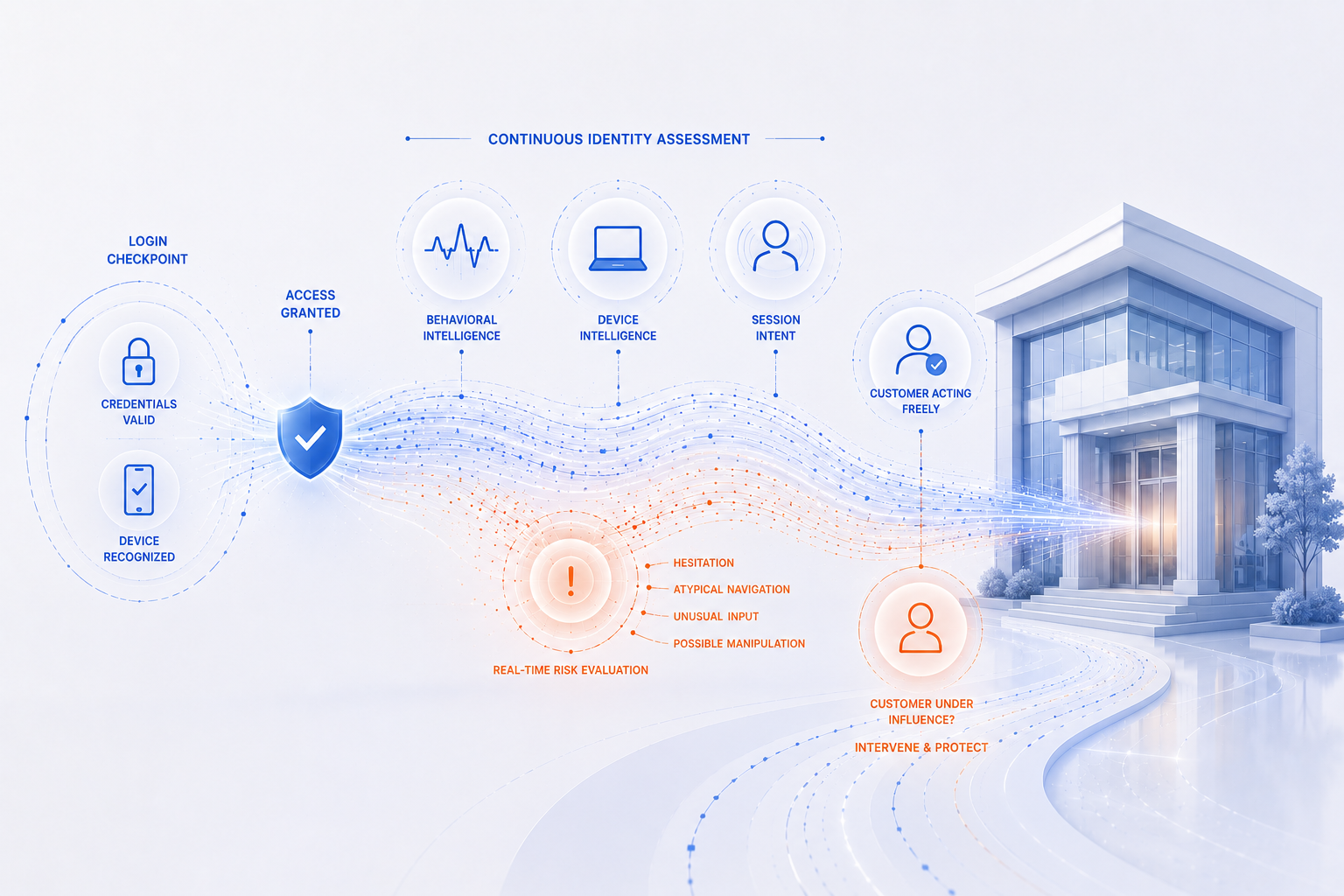
The only way to differentiate between these two seemingly identical users is to consistently and persistently evaluate their intent throughout every millisecond of every transaction.
The rearview mirror problem
Most fraud systems today rely heavily on historical event data:
- Transaction values
- Device identifiers
- IP addresses
- Geolocation
- Historical activity
This data is valuable but limited. It shows only what’s already happened. Like a car’s rearview mirror, it only reveals where we’ve already been.
Has this device been seen before?
Is this transaction typical for this customer?
Does this fit historical patterns?
Historical event data like this cannot reliably predict future actions. Sophisticated attackers today utilize legitimate credentials, familiar devices, and expected behaviors to create patterns matching past events.
Relying on this transactional data alone creates a structural disadvantage. Detection lags, models become reactive instead of proactive, and fraud is too often identified too late.
Using behavior to predicting risk through intent
If such data offers only a rearview mirror perspective, behavioral intelligence reveals the road ahead. It focuses not on past events but on how actions unfold in real time and what they imply for what comes next.
This is the foundation of BioCatch’s behavioral intelligence. It analyzes human interactions across sessions to determine intent in real time. Instead of static checkpoints, behavioral intelligence continuously observes:
- How a user navigates
- How they interact with menus
- How they input and edit data
- How they transition between screens
- How they respond to prompts or friction
These signals form a dynamic behavioral profile that reveals intent as it emerges.
Returning to our example of those two seemingly identical users, one legitimate and one fraudulent: Behavioral intelligence allows us to see that the genuine customer behaves with familiarity, confidence, and consistency.
The fraudster may at first show a similar degree of familiarity, but their behavior then diverges from that of a genuine customer. Overly linear navigation may suggest scripted activity and copying and pasting of credentials may point to credential stuffing or remote access. Manipulated victims meanwhile often exhibit hesitation indicating uncertainty or coaching, unnatural flows, or signs of external control.
These are not historical artifacts but leading indicators of risk. This marks the shift from looking back at what was normal to predicting abnormalities before losses occur.
Why the distinction matters
The difference between rearview data and predictive behavioral insights has practical operational consequences. When organizations rely primarily on historic data, fraud detection is too often rules-based (e.g. transaction thresholds), controls are applied broadly to compensate for uncertainty, false positives increase, customer friction rises, and the user experience declines. Without confidence in intent, the system defaults to caution, challenging more users more often.
In contrast, when organizations understand intent through behavior, they identify risk earlier in every session, apply controls with accuracy, target fraudulent sessions directly, and allow genuine users to move seamlessly through every digital banking experience. This reduces the need for blanket friction and enables a far more efficient operating model.
A top bank in Latin America implemented a transaction monitoring system to address a surge in account takeover attacks. That solution prevented only half of all fraudulent transactions while delivering a high false-positive rate and an unmanageable workload of alerts to investigate. By deploying BioCatch’s behavioral intelligence, that bank boosted fraud detection rates above 90%, decreased fraud alerts requiring investigation by 70%, and reduced false positives by 66%.
In the United States, ORNL Federal Credit Union used BioCatch to save its more than 225,000 members $1 million in account takeover fraud losses in just six months.
Reducing friction and cost
Traditional account takeover defense strategies rely on one-time passcodes (OTPs), security questions, step-up authentication, and manual reviews. These controls are blunt and applied at scale, impacting many legitimate users to catch relatively few fraud cases. This creates an unnecessary trade-off between security and user experience.
Precisely applied friction changes this dynamic. By using behavioral intelligence to predict intent, financial institutions allow low-risk users to go about their digital banking experiences uninterrupted, while also identifying high-risk session earlier and handling them decisively, resulting in:
- Fewer false positives
- Higher-quality alerts
- Minimized manual workload
- Lower operational expenditure
A different top-tier bank in Latin America implemented stringent facial recognition authentication to deal with escalating fraud impacting its millions of customers. The bank managed more than 400 different rules, requiring a team of eight technical SMEs just to maintain, refine, and create new ones. By switching to BioCatch’s account takeover solution, the bank not only prevented $10 million in fraud losses but also reduced physical biometrics costs by 90% and decreased time spent managing rule-based systems by 50%.
Behavioral intelligence creates targeted rather than indiscriminate account takeover defenses, which, crucially, grow less visible to genuine customers.
From detection to prevention
The ultimate advantage of a predictive approach is the ability to move from detection to prevention. Rearview mirror data tells us only where fraud has already occurred. Behavioral intelligence allows us to stop that fraud before it happens.
Behavioral data gathered throughout the session enables financial institutions to interrupt suspicious journeys, block or delay high-risk transactions, trigger adaptive authentication only when needed, and challenge customers who may be manipulated. This approach transforms fraud management from investigating losses to preventing them entirely.
The business case is clear: Fewer reimbursements and investigations, faster, more confident decisions, best-in-class customer experience, and reduced customer churn. Prevention becomes scalable by relying on real-time understanding rather than historical inference.
Account takeover can no longer be solved by looking in the rearview mirror. When attackers mimic normality, historical data alone cannot provide answers and will always lag behind evolving tactics.
The future of fraud defense lies in understanding user intent in real time. In modern fraud, the key question is no longer: What just happened? It’s: What is about to happen, and why?
—
Key takeaways:
- Precision hinges on understanding intent: As financial crime tactics grow more sophisticated, real-time behavioral analysis has become essential to distinguish intent and accurately classify risk.
- Fraud has evolved beyond authentication failures: Modern attackers often use valid credentials and mimic normal behavior, or manipulate victims through social engineering, making detection far more complex.
- Historical data creates a reactive “rearview mirror” problem: Transactional and device data show past behavior but fail to predict emerging threats, leaving institutions structurally behind sophisticated fraud tactics.
- Behavioral intelligence enables proactive, precise controls: By analyzing how users interact in real time, institutions can detect risk earlier, reduce false positives, and apply friction selectively rather than broadly.
- The shift from detection to prevention improves outcomes: Real-time insight into intent allows institutions to stop fraud before losses occur, lowering costs, reducing customer friction, and improving overall user experience.
Resources:
- Case study: Top LATAM Bank Drastically Increases Fraud Prevention & Reduces False Positives by 66% with Behavioral Intelligence
- Case study: How ORNL FCU shut down account takeover and stopped $1M in fraud
- Anthropic: Detecting and countering misuse of AI
- ResearchGate: AI-Based Behavioral Biometrics for Fraud Prevention in E- Commerce
- Blog: The value of precision in account opening
- Blog: The value of precision in stopping scams
- Blog: The value of precision in disrupting mule networks
Deutsch
español
français
italiano
português