
In fraud prevention, what you don't flag matters just as much as what you do.
To the uninitiated, stopping fraud may seem simple: Alert on everything, stop anything remotely suspicious, cast a wide net. But this is a fallacy.
This logic quickly falls apart with Authorized Push Payment (APP) scams, where the customer, often unaware of manipulation, initiates the payment. In this context, excessive alerts become a liability.
Those banks that excel at scam-prevention have learned precision is key. By reducing false positives and unnecessary interventions, they enable more targeted, confident actions at the right moments in time.
The hidden cost of being wrong
When a fraud alert incorrectly flags a legitimate payment, the costs are rarely captured in a single spreadsheet. But they are very real.
There’s the operational burden: Every false positive generates a new case. That case requires a fraud analyst, an investigator, and sometimes an escalation. According to The Knoble’s pragmatic framework for measuring APP scam impact, operating costs across reporting, investigation, and escalation can reach more than $131,000 per 1,000 cases, even before a single dollar of fraud loss is on the table.
Then there’s the customer experience. A payment wrongly blocked, a call center interaction that goes nowhere, a moment where a customer feels doubted rather than protected: Each of these chips away at exactly the trust that financial institutions are trying to safeguard. Research from Javelin Strategy & Research found that nearly seven in 10 scam victims reached out to their bank or credit union after a scam incident. Banks that cry wolf on legitimate transactions risk jeopardizing the very relationship they need when a real scam occurs.
And then there’s attrition: The Knoble's framework calculates customer attrition costs at more than $420,000 per 1,000 cases, factoring in lifetime value and acquisition costs. Lose a customer over a false alarm, and you're paying twice: once to replace them, and once in the revenue you’ll never see.
False positives not only waste time but also weaken trust, inflate operating costs, and drive away the customers you’re trying to protect.
Why scams demand a different kind of precision
Traditional fraud tools were built for a different problem. Unauthorized fraud, account takeover, card fraud, and credential theft leave a clear evidentiary trail. Something happened that the customer didn’t authorize. The breach is identifiable, and the loss is directly attributable.
APP scams are structurally different. The customer authorizes the payment. The transaction, viewed in isolation, can appear entirely normal. A person transfers money to a new payee. So what? People do that every day.
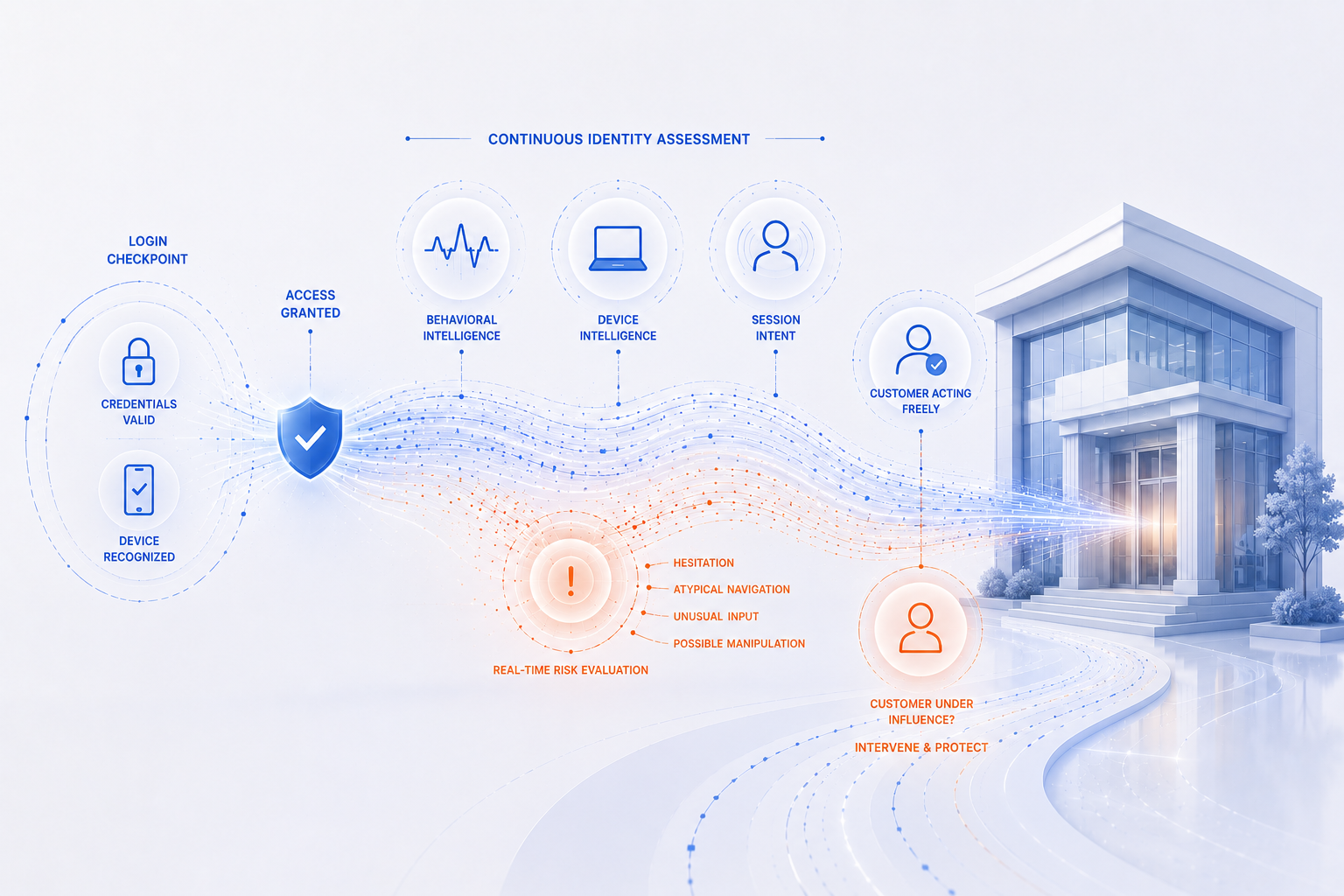
What distinguishes a scam from a genuine payment is the behavior surrounding the transaction instead of the transaction itself. The accountholder might hesitate before entering an amount, spend an unusually long amount of time on the payee screen, have an active call running the background, or create a pattern of inputs that doesn’t match how this person typically interacts with their banking app.
This is precisely where Scams360 operates. By analyzing live digital sessions for cognitive and behavioral signals, Scams360 can detect manipulation as it’s happening and before any payment leaves the would-be victim’s account.
What precision looks like in practice
One of the largest banks in the U.K. was already heavily invested in fraud technology, transaction monitoring, device analysis, malware detection, and custom solutions. And yet social engineering voice scams were still breaking through, costing hundreds of thousands of pounds every month and damaging customer confidence.
Working with BioCatch, the bank deployed a behavioral intelligence approach to detect the human signals of manipulation in real time and started saving $675,000 in fraud losses per month. This approach was driven not by blanket blocking but by precise, behavior-driven intervention at the critical moments in a payment journey.
That kind of outcome isn’t possible with a high false positive rate. Over-alerting would have generated thousands of unjustified interventions, consumed analyst resources, frustrated genuine customers, and ultimately undermined confidence in the system itself. The bank succeeded because the detections were precise, targeted at real manipulation, and backed by behavioral evidence.
Five scam types, one consistent thread
Scams360 is built to cover the full spectrum of major authorized fraud methods, including bank impersonation scams, business email compromise, romance scams, investment scams, and purchase scams. Each has its own surface characteristics. But across all of them, the behavioral signatures of manipulation follow reliable patterns:
- Impersonation voice scams: active call screen broadcasting, hesitation, delayed inputs, anomalous navigation, extended session times
- BEC: rare typing behaviors, window-toggling behavior as victims read fraudulent payment instructions, and accumulated amount anomalies
- Romance scams: hesitation at the payment stage, longer click times, unusual geographic indicators
- Investment scams: remote access or screen broadcasting, payment velocity anomalies, crypto-related activity
- Purchase scams: distracted mouse movements, frequent app-switching, first-time installs of risky applications
The models that drive Scams360 learn from real-world scam activity and adapt continuously to new and emerging methods. While the anatomy scams constantly evolve, the way we humans respond to their manipulation leaves consistent cognitive traces, meaning behavioral intelligence remains effective even as fraudsters update their tactics.
Critically, those same models are calibrated to distinguish manipulation from normal behavior. A customer making a payment while on the phone chatting to a friend or reimbursing a colleague should not trigger a scam alert. A customer on a call they didn’t initiate, navigating to a new payee they’ve never used, spending three times as long as usual before confirming is very different.
The business case for getting it right
The Knoble’s framework for measuring APP scam impact provides a clear financial picture, one that goes well beyond the direct loss figures. For a sample of 1,000 scam cases, the total business cost (operational, attrition, compliance, and accommodation) is approximately $599,000, in addition to the deposit losses to customers themselves, which add another $9.37 million.
Those numbers illustrate the scale of the problem. But they also point to where precision delivers compounding returns. Every false positive removed from the pipeline reduces the operational cost. Every genuine customer protected and retained reduces attrition. Every intentional intervention that stops a real scam reduces direct customer loss and the reputational damage that follows.
Precision is the business case. A solution that fires accurately, catching manipulation early while leaving genuine transactions unimpeded, not only reduces loses but also prevents them. It lowers operating costs, preserves the customer relationship, reduces attrition risk, and positions the bank as a loyal partner rather than an obstacle.
Precision as a competitive advantage
In a regulatory environment where U.K. banks are now required to reimburse APP fraud victims up to £85,000 per claim under PSR rules, the financial stakes of getting detection wrong have never been higher. The price of inaction is rising, but so too is the cost of imprecision.
Banks that invest in scam controls need those controls to work. Flagging activity alone isn’t enough. Controls must also flag the right activity, at the right time, with the confidence to act. Scams360 is built on that principle. Behavioral intelligence doesn’t cast a wide net and filter after the fact. It targets the cognitive and behavioral signals of manipulation, specifically, as they occur in the moment.
Precision in scam detection is a strategic differentiator that drives real results, lowering costs, building trust, and protecting customer relationships. As banks face growing regulatory and financial pressures, those who prioritize accuracy and targeted action will be best positioned to deliver value, foster long-term loyalty, and lead the fight against scams. In the evolving landscape of fraud prevention, precision pays for itself.
—
Key takeaways:
- False positives create economic costs, unnecessary friction, and customer distrust as surely as missed fraud does.
- Effective scam prevention depends on targeted intervention at high-risk moments rather than blanket blocking or excessive alerts.
- Precisely applied friction in the form of behavioral intelligence lowers operational costs by reducing unnecessary investigations, escalations, and manual reviews.
- One major U.K. bank saved $675,000 in fraud losses per month by deploying behavioral intelligence.
- As reimbursement rules and regulatory pressure increase, precision in scam detection becomes a competitive advantage, not just a fraud-control metric.
Resources:
- Case study: Top-five UK bank saves £500K per month in fraud losses by preventing social engineering voice scams using behavioral insights
- Solution: Scams360
- White paper: The emotional undercurrent of financial scams
- Blog: The value of precision in combating account takeover
- Blog: The value of precision in account opening
- Blog: The value of precision in disrupting mule networks
- Guide: Measuring the impact of authorized push payment scams: A practical framework for financial institutions
Deutsch
español
français
italiano
português