Imagine two digital banking sessions beginning within the same minute.
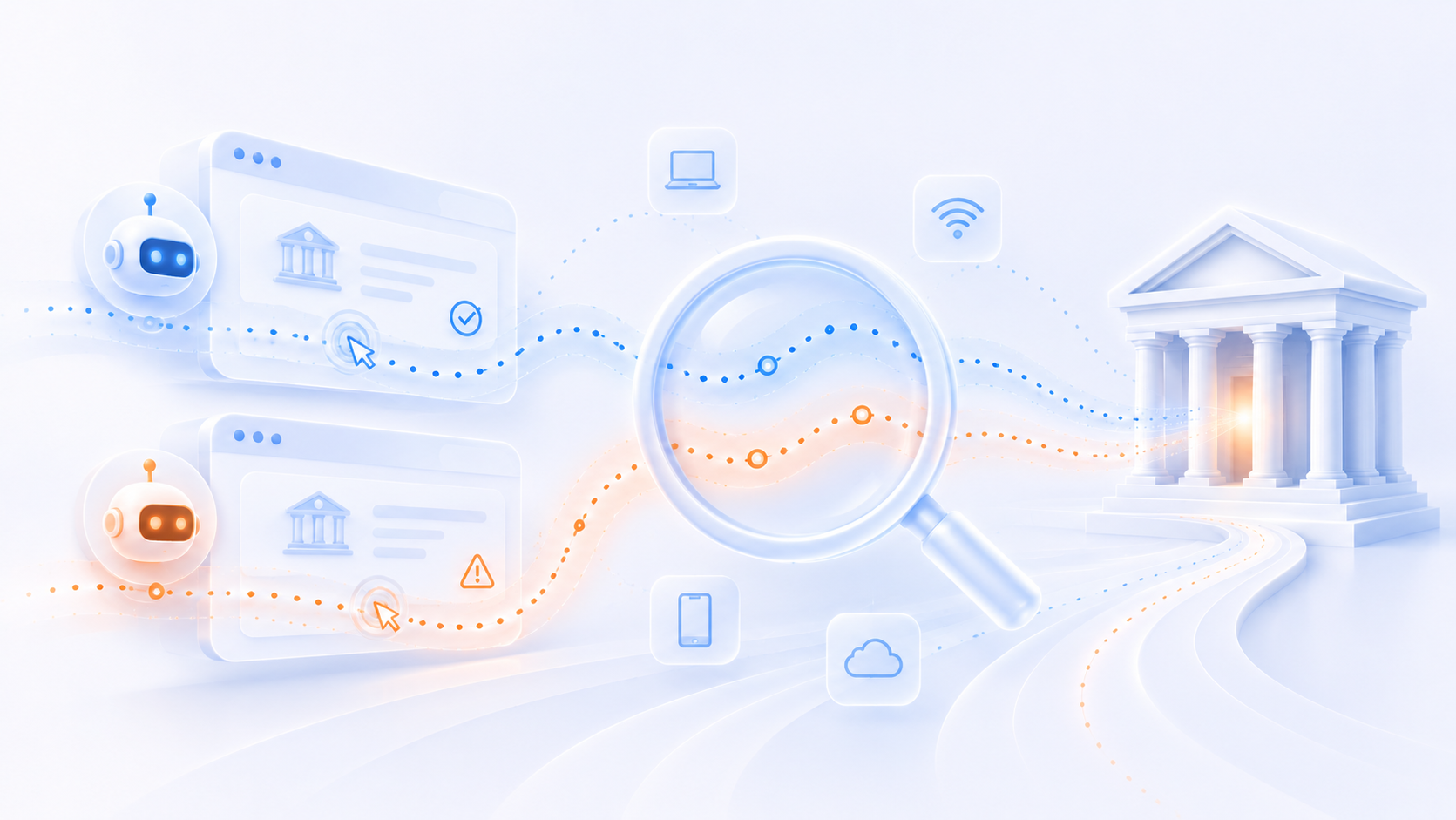
In the first, a customer I’ll call Maya has asked her AI assistant to pay her electric bill, as she does every month. In the second, a fraudster’s agent is using Maya’s stolen credentials to pass multifactor authentication, add a new payee, and empty Maya’s savings account.
Both agents log in successfully and proceed to the payments screen without any hesitation.
A fraud detection model that only knows what Maya usually does might struggle to tell these two sessions apart. But a fraud detection system that also watches how each session unfolds and continually assesses the browser’s permissions, the infrastructure behind the agent, and the network it uses will recognize two very different agentic visitors.
The challenge illustrated by these two agentic banking sessions is already raising concerns across the financial services industry.
What the research reveals
Datos Insights recently published Agents are here; Standards aren't: Closing the agentic AI gap, a report sponsored by BioCatch. The report’s authors, Datos Insights strategic advisers Jim Mortensen and Serpil Hall, surveyed 155 fraud and anti-money laundering executives across the U.S., the U.K., India, Australia, and Latin America.
The findings reveal significant gaps in bank readiness. Only 18% of respondents report having a dedicated capability to tell a customer-authorized AI agent from malicious automation in real time. Meanwhile, 83% expect it to get harder to produce authorization evidence when customers dispute agent-initiated transactions.
Datos also nails the governance gap: Banks are deploying AI agents faster than they can govern them, and Regulations E and Z, raise additional questions about how liability applies when an AI agent initiates an unexpected or unauthorized transaction.
But one statement in the Datos report could leave readers with the wrong impression about the role of behavioral detection in an agentic future.
Can AI agents evade behavioral detection?
One of the report’s key findings says traditional fraud systems authenticate humans by monitoring behavioral patterns, and that agents “shatter this foundation by operating consistently without behavioral deviation.”
Read quickly, that line suggests behavior no longer works against agents. But when we asked Datos to clarify, the firm confirmed that the statement refers to behavioral analytics and not behavioral biometrics, which the report did not evaluate.
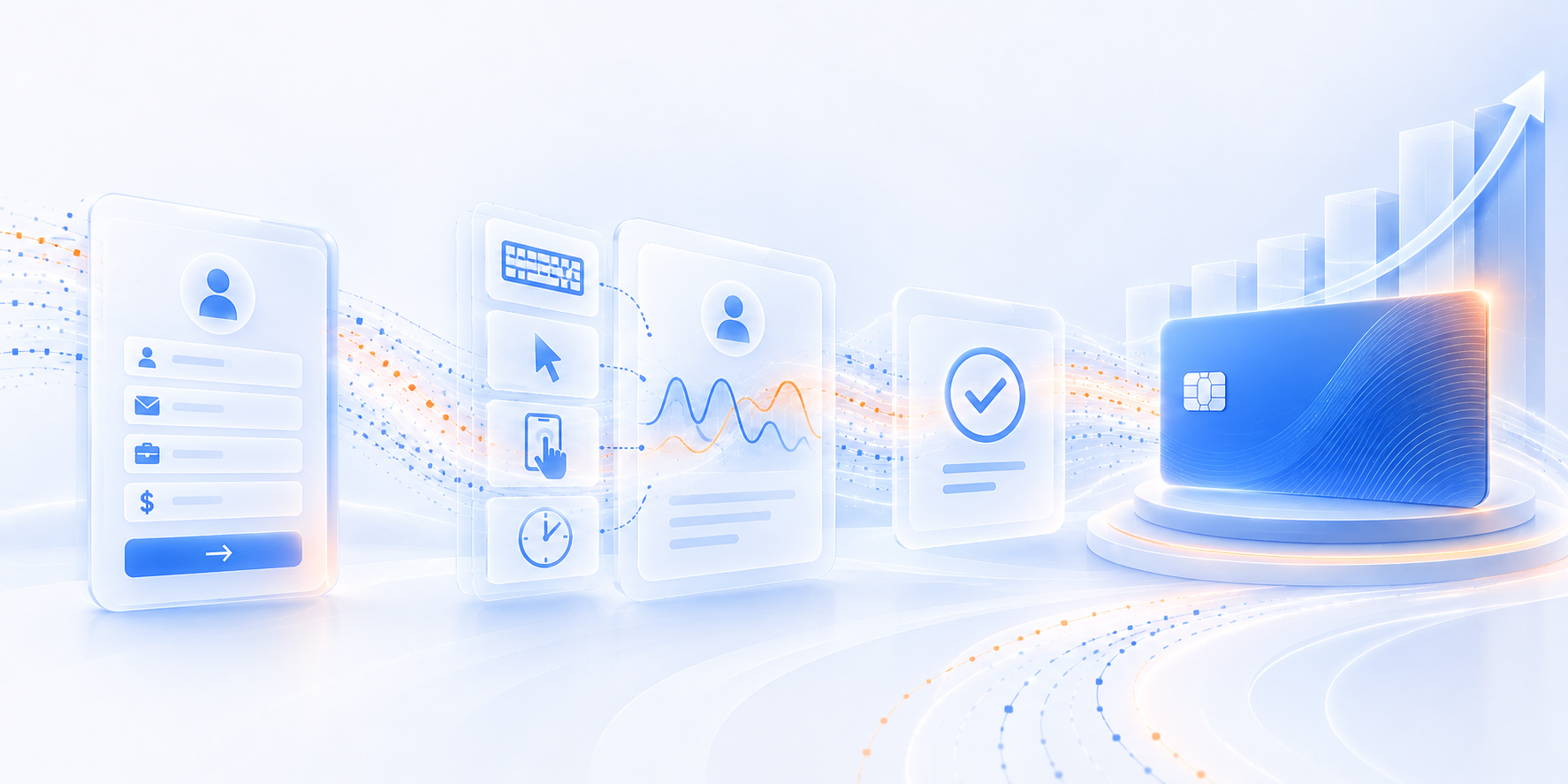
The two terms describe very different things. Behavioral analytics tracks what a customer does: which payees she pays, how much she spends, and when and where she logs into her account. Behavioral biometrics tracks how someone interacts with a digital channel: typing cadence, mouse movement, touch pressure, phone angle, and the path through each screen.
Datos’ point about behavioral analytics makes sense. Consider Maya’s electric bill: If her AI assistant pays the same bill, for the same amount, on the same day, the transaction itself may look perfectly normal. But the way the agent navigates the banking session, enters information, and completes the payment can reveal that it’s automated. Behavioral biometrics asks a different question, and agents answer it very differently than people do.
Consistency is the tell
People are messy. We pause to reread a field, fix typos, and tilt our phones as we walk. Our cursors drift and curve.
Agents often behave differently. They may fill fields with uniform timing or inject text all at once, click precisely where they intend to, and take the most efficient path through every screen. For BioCatch, these patterns are among the clearest signals an agent leaves behind.
That consistency, which can make an agent’s transactions harder to distinguish through behavioral analytics, may also help expose automation through behavioral biometrics.
What happens when agents start acting human?
Of course, fraudsters will train their agents to imitate human behavior, introducing elements like jitter, random pauses, and curved mouse movements. That raises the bar for detection, but it doesn’t defeat it.
Human interaction involves more than a single signal. Depending on the device and channel, sessions can generate data about typing speed, touch pressure, device location, movement, and orientation data. BioCatch examines multiple signals and how they relate to one another.
An attacker who perfects typing rhythm may still struggle to consistently reproduce touch pressure, device motion, and dozens of other measurements. Faking one dimension is achievable. Faking all of them at once while keeping them consistent is extremely difficult.
Behavior works best with device and network intelligence
Behavior tells a bank how a session moves. Device and network intelligence tell the bank where the session lives.
AI agents run somewhere, whether in a headless browser, an emulator, or a cloud virtual machine. Those environments can leave identifiable traces, even when an agent imitates human interaction. Even if an AI agent flawlessly imitates human behavior, the underlying automation technology may still leave detectable traces.
A session claiming to originate from a mobile device but showing no expected touch activity deserves a closer look. So does a session that arrives through a data center or a residential proxy when the customer normally logs in from a home internet provider.
The underlying automation framework may also leave patterns across repeated attempts. A blocked agent, for example, may return repeatedly, attempting to access increasingly high-risk functions, such as adding a new payee.
Now return to Maya’s two sessions. Her authorized assistant behaves like a machine, but it follows a familiar pattern, connecting from the same service and staying within its usual bill-pay activity. The fraudster’s agent, meanwhile, operates from an unfamiliar environment, hides behind a proxy, and immediately attempts to add a new payee.
No single signal establishes whether an agent is legitimate or malicious. But behavior, device, and network intelligence together make the difference clearer.
That combination drives BioCatch’s approach to agentic AI detection: First, identify whether an agent is driving the session. Then assess whether its activity and environment are consistent with an agent the customer has authorized.
Where behavior stops and standards start
Datos lays out four questions banks must answer for every agentic transaction: Is this the right agent? Does it have appropriate permissions? Did the customer properly authorize or delegate authorization for this specific transaction? Has the customer revoked that permission?
Behavioral, device, and network signals answer the first two questions well. But these signals alone can’t prove that Maya authorized today’s payment or that she hasn’t since revoked her assistant’s access. That takes cryptographic delegation records and revocation that reaches every platform within seconds.
Datos calls for industrywide standards around agent identity, delegation, and revocation, and rightly so. But banks can’t afford to wait for those standards before investing in detection. AI agents are already entering digital banking, and financial institutions need visibility into their activity today.
Agents leave tracks
Agents leave a different digital footprint than humans do, even when they try to imitate us. Agents leave a machine footprint, with its own rhythm, tooling, and address. Fraud fighters who know how to read those signals can spot the difference between Maya’s trusted assistant and the criminal agent using her credentials, without waiting for industry standards to catch up.
AI agents may change the patterns banks look for, but they certainly don’t make behavioral detection obsolete.
BioCatch will keep studying how these agents move and sharing what we learn with Datos and the broader industry. The banks that pair strong detection with the standards Datos calls for will be better equipped to protect customers while giving them the freedom to bank with AI agents they trust.
—
Key takeaways:
- AI agents aren’t invisible to behavioral detection. Their automated interactions can leave identifiable patterns.
- Behavioral analytics and behavioral biometrics are different. The former examines what users do; the latter examines how they interact.
- Imitating human behavior doesn’t guarantee evasion. Device, network, and automation signals can still reveal AI agents.
- Detecting an agent is only the first step. Banks must also assess whether its activity is authorized or potentially malicious.
- Detection and industry standards must work together. Banks need visibility into AI agents today, alongside stronger standards for identity, delegation, and revocation.
Resources:
- Report: Agents are here; Standards aren't: Closing the agentic AI gap
- Solution: BioCatch AiRE™
- Survey: The future of digital trust: AI agents and the speed of fraud and financial crime
- Blog: Fraud in 2027: 23 experts offer predictions about what’s to come
- Reuters: U.S. banks are blocking third-party AI agents access to customer accounts, sources say
- Blog: What is behavioral intelligence?