
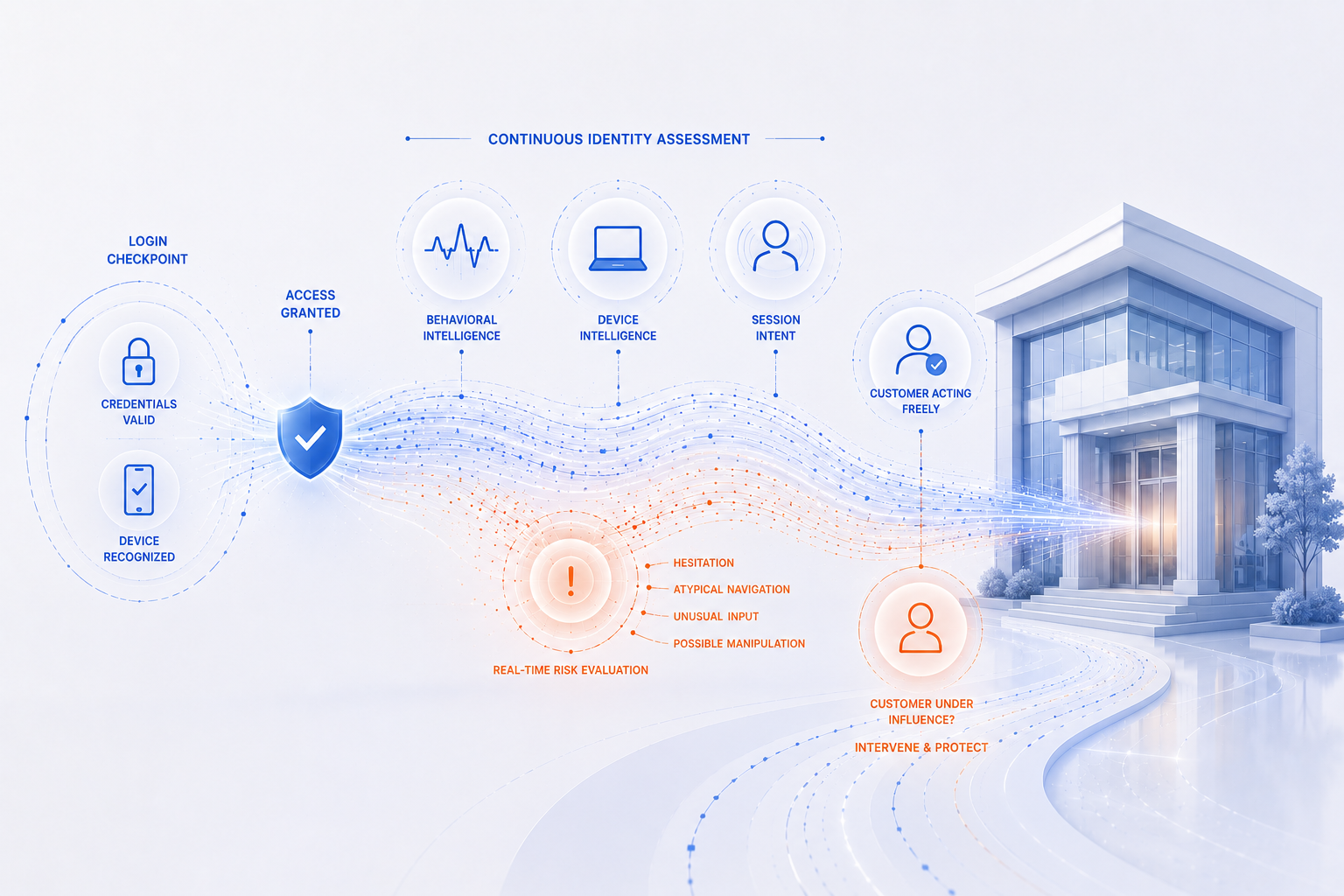
For 30 years, authentication systems sought to answer two questions:
- Are these credentials valid?
- Is this device recognized?
If the answer to both was “yes,” the system allowed the session to proceed.
At many institutions, this model persists today, but evolutions in both fraud tactics and the systems banks deploy to stop fraud have exposed legacy authentication systems as fundamentally incomplete. When a genuine user logs in and passes every authentication factor, the system then treats the rest of the session as authorized. If someone else begins influencing that session after the verified login (through remote-access controlling of the device or real-time social engineering to manipulate an accountholder into willingly authorizing a transfer), the system has no reason to revisit its original judgment.
The authentication paradox
As fraud threats have evolved, banks have continued adding layer after layer of authentication methodology: increasingly complex passwords, multi-factor authentication, one-time passcodes, push notifications, physical biometrics, and more. Each additional layer reduces fraud, but with diminishing returns.
At the same time, with more factors, more complexity, and more moments where a legitimate customer has to prove that they are who they say they are, friction continues to increase.
In theory, stronger authentication should reduce the need for this friction. Instead, it requires more friction because we’re applying controls that were never designed to answer the question authentication is actually being asked to answer.
The session is not the login
Device intelligence can evaluate whether the device has been compromised or is running remote access software. That’s useful.
Behavioral intelligence can read how the person is interacting with the session (typing cadence, navigation speed, hesitation at decision points). That’s even more useful.
But in most institutions, each of these signals sits in a separate fraud detection layer rather than feeding directly into the identity system’s ongoing assessment. The teams responsible for authentication built what first-generation tooling allowed them to build. They successfully answered: Are these credentials valid? and Is this device recognized?
But identity teams were never asked to answer the question they should have been asked: Is this person acting on their own intent?
The next generation of identity is continuous
The institutions stopping the most fraud while also preserving the smoothest user experience no longer treat identity as a checkpoint achieved at login. They treat it as an ongoing assessment that runs continuously throughout the session.
That assessment still starts with credentials, multi-factor authentication, and device recognition, but then continues as the session unfolds and behavioral intelligence feeds continuous signals about how the person is interacting. Are they hesitating? Navigating unusually? Entering atypical values? Are they being manipulated?
This approach reveals something that point-in-time authentication can never see: the difference between a customer acting freely and a customer acting under duress.
What this solves
Behavioral intelligence immediately resolves the authentication paradox. Banks are no longer applying friction at random intervals because the system lacks confidence. They can instead intervene only where behavioral signals suggest the customer needs protection.
The result:
- The same level of security with dramatically less friction for the customers who never needed it in the first place
- Earlier intervention for the customers who are being manipulated, often minutes before a loss becomes inevitable
For CISOs and CIAM leaders, this represents a fundamental shift in architecture, from static fingerprinting and credential validation toward continuous behavioral assessment, from identity verification as a moment to identity assessment as an ongoing process.
We spent three decades getting better at answering what are now the wrong questions. The next era belongs to institutions that shift to the right one.