
For the last decade, fraud, cybersecurity, and money laundering were genuinely different problems, confined within their own domains and protected against by unique systems each managed by teams with specific expertise. Fraud teams managed origination and transaction controls, cybersecurity teams protected system integrity and device security, and AML teams reviewed suspicious activity retrospectively, looking for patterns indicative of money laundering.
Over the last few years, the threat landscape has changed thanks to the converging of three forces:
- Real-time payments compress the window for bank intervention from days to seconds.
- Artificial intelligence enables bad actors to exponentially personalize and scale their attacks.
- Fraudsters now target people as aggressively as they do systems.
The result is an interconnected financial crime ecosystem. Bots attempt origination, bad actors remotely access devices owned by legitimate customers to take over sessions and make scam payments, and millions of mule accounts pass seamlessly through account opening journeys, receive inbound transfers, and trigger AML alerts after the funds have already moved.
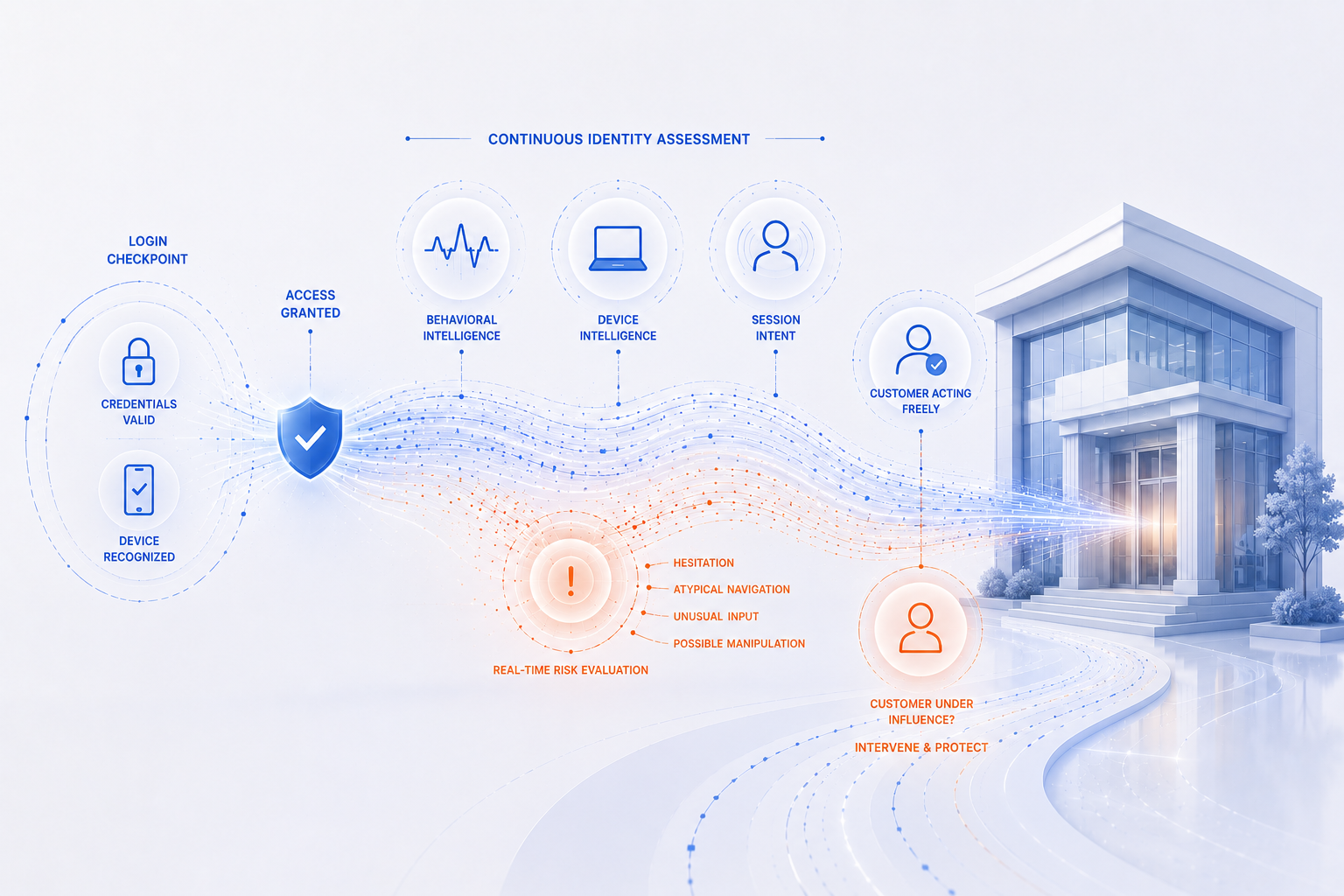
The financial institutions that continue to address fraud, cybersecurity, and AML as three distinct problems struggle to consistently identify this deluge of interconnected attacks. Existing controls are effective at verifying identity at log-in, validating access, and monitoring transactions, but they were not designed to assess user intent during all of the hundreds of seconds that transpire between those point-in-time ID checks.
The missing layer
Behavioral intelligence runs continuously between every checkpoint. It evaluates not only what is happening but also how, distinguishing a genuine customer from a synthetic identity, identifying a scam payment before the money moves, and recognizing a mule account during its first sessions rather than its 100th transaction.
This is the layer that enables three previously separate teams to speak the same language. Fraud prevention leaders ask: Is this application genuine or fraudulent? Cybersecurity leaders ask: Is the device compromised? AML leaders research: Is this activity suspicious? Behavioral intelligence answers all four questions simultaneously. Its signals inform every decision point. A bot signature in an origination application triggers fraud escalation. Session behavioral anomalies inform authentication decisions. Device compromise patterns trigger fraud escalation and AML review. Mule account indicators surface early, before inbound transfers arrive.
Behavioral intelligence gives financial institutions a shared source of truth that enables distinct teams to connect previously isolated insights, moving beyond detection in isolation to enable early intervention.
The strategic opportunity
For chief risk officers, this is about visibility. Behavioral intelligence provides a way to detect manipulation and fraud earlier in the session, before a transaction is authorized, before funds move, and before losses are locked in.
For information security leaders, this is about understanding that the digital banking attack surface has shifted. Security is now just as much about systems as it is about people, sessions, and intent.
For financial crime leaders, this is about recognizing that the architecture designed to catch fraud, cybersecurity threats, and money laundering separately is inherently incomplete. The next generation of financial crime management must be unified because today's operating environment requires it.
The institutional question
Most banks are still investing in better tools within existing silos: better fraud detection, better device fingerprinting, and better AML monitoring.
The institutions ahead today and poised to detect the most fraud, achieve the best ROI, and most reduce customer attrition in the future are asking a different question: What is no one seeing because we’re all looking at our piece in isolation? The answer, consistently, is the behavioral intent behind every digital banking interaction.
Behavioral intelligence is the missing signal that can unify all the others. An integrated architecture with behavioral intelligence as its bedrock enables fraud, cybersecurity, and AML teams to connect their insights and act together, allowing the organization to evolve from a reactive institution to a proactive one.
—
Key takeaways:
- Real-time payments, AI, and social engineering have collapsed the traditional boundaries between fraud, cybersecurity, and AML, turning them into a single, interconnected financial crime challenge.
- Banks that continue to manage fraud, cybersecurity, and AML in separate silos risk missing attacks that span multiple stages of the customer journey.
- A single behavioral signal layer helps fraud, cybersecurity, and AML teams make faster, more informed decisions from the same source of truth.
- Identifying compromised devices, scam victims, bots, and mule accounts early allows financial institutions to intervene before losses occur and investigations begin.
- Financial institutions that unify fraud, cybersecurity, and AML around behavioral intelligence will be better positioned to reduce losses, improve customer experience, and respond to modern financial crime.
Resources:
- Blog: What is behavioral intelligence?
- IDC: Worldwide Banking Enterprise Risk Management and Compliance Technology Trends, 2026
- Blog: The Recognition Economy: A new framework for how banks will compete
- Blog: IDC recognizes behavioral intelligence as most critical signal layer