In April 2025, I wrote that the war was coming. I described how agentic AI, capable of autonomously planning and executing complex, multi-stage tasks, was poised to be weaponized against the financial services sector. I argued that criminals, unencumbered by ethics, regulation, or the fear of failure, would adopt this technology faster than the institutions tasked with stopping them. Most importantly, I warned that agentic AI was not a peripheral risk to be monitored from a distance. It represented a fundamental shift in the nature of financial crime.
Some people nodded. Some asked for more evidence. Some, I suspect, moved on to the next agenda item.
In March 2026, INTERPOL published its Global Financial Fraud Threat Assessment. I’ll be honest: I didn’t enjoy being right.
The warning
The premise of my original blog was straightforward: Criminals are rarely followers. They are early adopters, unconstrained by the governance, procurement cycles, and risk committees that slow legitimate businesses down. Agentic AI represented a step change in what criminal operations could achieve. Unlike chatbots or text generators, these systems can make decisions and execute complex tasks autonomously, giving criminals the ability to operate with unprecedented scale, speed, and adaptability.
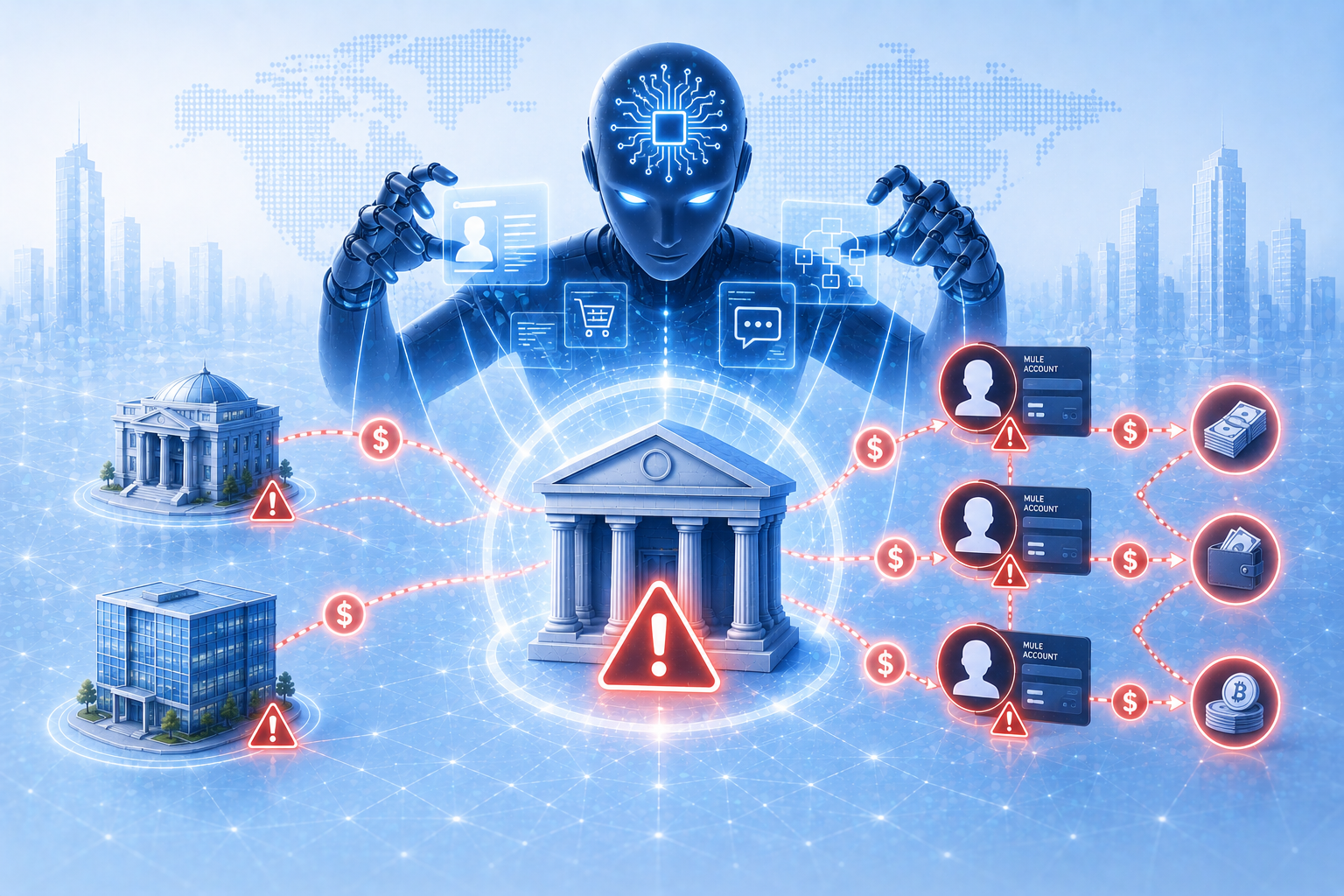
I mapped the threat across the major fraud and financial crime challenges facing banks. At account opening, I warned that agentic AI would enable fraudsters to create and adapt synthetic identities in real time. In account takeover, I highlighted the emergence of AI-augmented phishing and the growing challenge of distinguishing legitimate customers from autonomous agents.
I argued that the same dynamic would reshape scams and money mule activity, allowing criminals to automate social engineering, optimize campaigns continuously, and scale recruitment and management operations.
The underlying argument was this: The same efficiencies and return on investment that make agentic AI attractive to legitimate businesses make it equally attractive to criminal enterprises. The business case was obvious. Every forecast pointed to rapid adoption across the legitimate economy. We should have assumed criminals would move even faster.
What INTERPOL found
Thirteen months later, the world's largest international police organization reached many of the same conclusions in its formal threat assessment.
AI-enabled fraud is now 4.5 times more profitable than traditional methods. Agentic AI systems are now capable of autonomously planning and executing complete fraud campaigns, from reconnaissance to the final demand. Those are INTERPOL's words, not mine.
INTERPOL goes onto explain how criminal networks are increasingly collaborating with specialized money laundering groups, sharing expertise and infrastructure to scale operations globally. And scam centers, once largely associated with Southeast Asia, have become a global phenomenon, industrialized in their operation and powered by technology.
INTERPOL Secretary General Valdecy Urquiza described this shift as the “industrialization of fraud.” That phrase deserves a moment of reflection. This is no longer primarily an opportunistic crime carried out by individuals. It is increasingly organized, automated, and optimized for return on investment, much as I argued it would become.
The finding that AI-enabled fraud is 4.5 times more profitable than traditional methods is the statistic that should command attention in every fraud strategy meeting. It means that for every pound generated by a traditional fraud operation, an AI-enabled campaign can generate four and a half times more, giving fraudsters a readily available structural advantage that vastly exceeds mere incremental improvement.
The real lesson
I am not writing this to take a victory lap. I am writing this because the gap between identifying a threat and acting on it is where the real damage occurs.
When I published my analysis in April 2025, I was describing an emerging threat. The warning was based on what I could already see in the data, the trajectory of AI development, and the behavior of criminal networks that had repeatedly demonstrated their willingness to adopt new technologies faster than the sector could respond.
The INTERPOL report, published little more than a year later, describes a threat that has arrived.
Financial institutions are particularly exposed because they sit at the intersection of identity, trust, and money movement. Agentic AI attacks all three simultaneously. It can create identities, manipulate customers, automate account access, and scale financial crime operations in ways that were previously limited by human labor.
That gap matters enormously. Every month that a financial institution spends debating whether agentic AI is a near-term or long-term concern is a month in which criminal operations continue to compound their advantage. The finding that AI-enabled fraud is 4.5 times more profitable than traditional methods does not represent a ceiling. It represents a baseline — one that will likely improve as these systems mature, criminal networks share tooling and expertise, and the attack surface continues to expand.
The INTERPOL report also validates something we have long argued at BioCatch: The response to this threat cannot be purely static or rule-based. The defining characteristic of agentic AI is its ability to adapt. These systems test controls, identify weaknesses, and modify their approach accordingly. A defense built on fixed rules, known signatures, or periodic model updates is, by definition, fighting the previous war.
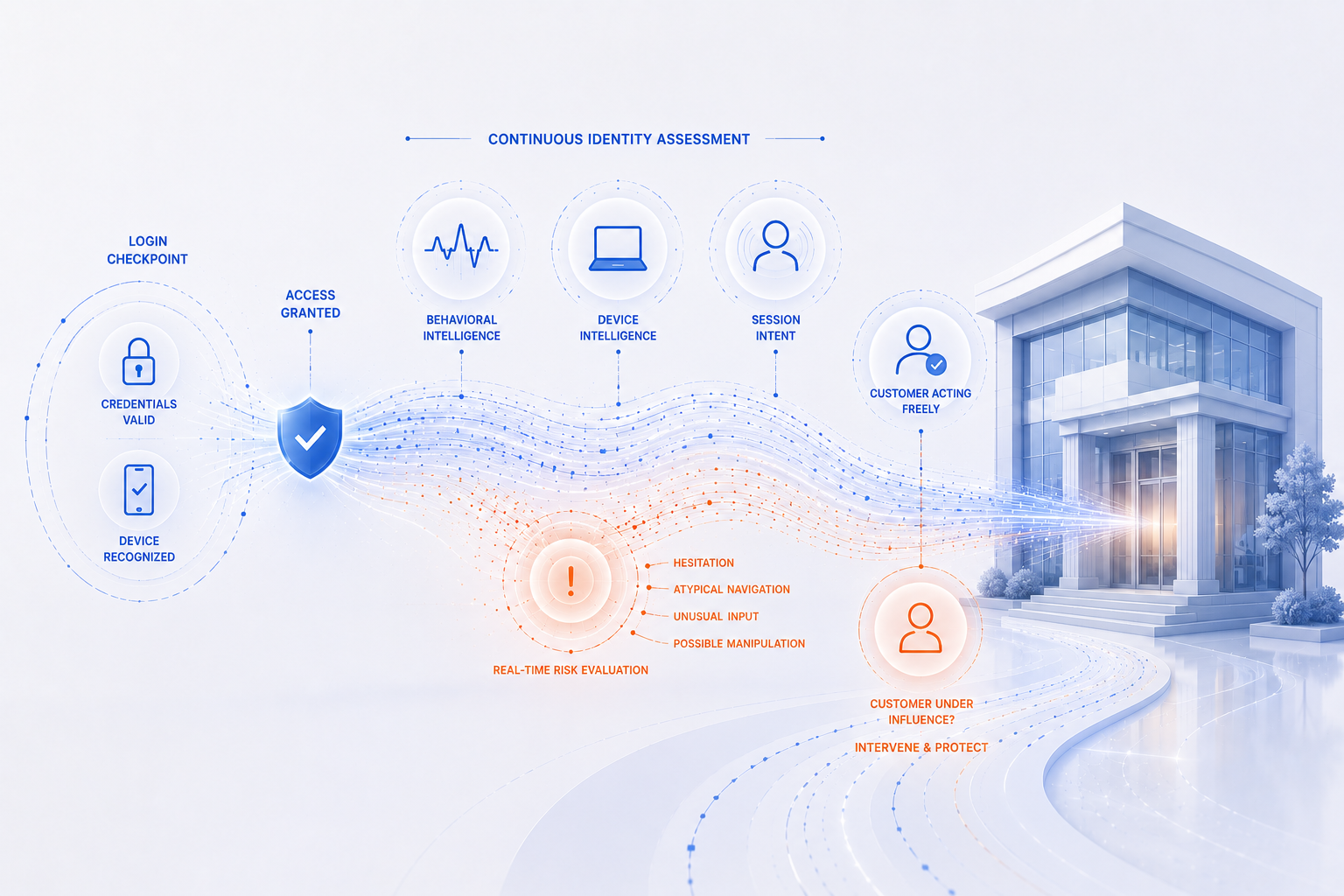
What is required is a behavioral approach, one that focuses not on what a user claims to be, but on how they actually interact with a system.
A fraudster can generate a synthetic identity. They can train a model to answer security questions. They can bypass a CAPTCHA. Replicating the full, continuous, and contextual behavioral signature of a legitimate customer across an entire session, multiple interactions, and an ongoing financial relationship is fundamentally harder.
Behavioral intelligence operates in a domain that remains exceptionally difficult to spoof at scale because it evaluates the thousands of small signals that distinguish genuine human behavior from manipulation, automation, and fraud.
That asymmetrical advantage is what BioCatch was built to provide.
The choice facing the industry
In April 2025, I framed the challenge as a choice between matching the threat and falling behind it. That framing still holds.
A competitive response requires the sector to move at the same pace as the criminal ecosystem. It means deploying AI to detect AI, using behavioral intelligence to identify non-human actors, and building consortium-level collaboration so that signals observed by one institution can protect many others. It means treating fraud not as a cost to be managed, but as an arms race to be won.
A slower, more cautious, and more reactive approach cedes the initiative. And with INTERPOL now documenting the consequences of that approach on a global scale, the argument for waiting has never been weaker.
The war did not arrive unannounced. It arrived exactly when, and largely how, we said it would. The question is no longer whether the threat is real. INTERPOL has answered that. The question is what you are going to do before the next assessment tells the same story on an even larger scale.
—
Key takeaways:
- INTERPOL's latest threat assessment validates a warning that many in the industry have been raising for more than a year: Agentic AI is no longer an emerging risk. It is actively reshaping financial crime.
- AI-enabled fraud is now significantly more profitable than traditional methods, giving criminal organizations a powerful incentive to accelerate adoption and scale operations.
- Financial institutions are uniquely exposed because agentic AI can simultaneously target identity, authentication, customer manipulation, and money movement.
- Static, rule-based controls are increasingly vulnerable to adaptive threats. Defending against agentic AI requires technologies that can identify and respond to changing behaviors in real time.
- The question is no longer whether agentic AI will transform financial crime. The question is whether institutions can adapt their defenses quickly enough to keep pace.
Resources:
- INTERPOL: Global Financial Fraud Threat Assessment
- Blog: The war is coming: Agentic AI and the next wave of attacks
- Gartner: Agentic AI Set to Transform Customer Service & Support Landscape, Reshaping Inbound Interactions and Forcing Service Teams to Embrace Automation
- Anthropic: Disrupting the first reported AI-orchestrated cyber espionage campaign
- Solution: DeviceIQ
- Report: The future of digital trust: AI agents and the speed of fraud and financial crime