IDC research finds 74% of banks see financial crime as the single greatest risk to their institution. And yet, most of those banks continue to operate with incomplete detection architectures. This doesn’t mean they lack tools. These institutions deploy transactional monitoring, device fingerprinting, identity verification, AML surveillance, digital intelligence, and more, but they’re without the one signal layer that is simultaneously the hardest for AI to fake and the most successful at detecting social engineering scams before money moves (a crucial capability as mandatory reimbursement becomes the norm in many geographies).
This is the structural problem solved by the Recognition Economy: the growth banks can realize when they pivot from asking “who are you?” to “are you transacting under the influence of someone else?”
One layer to rule them all
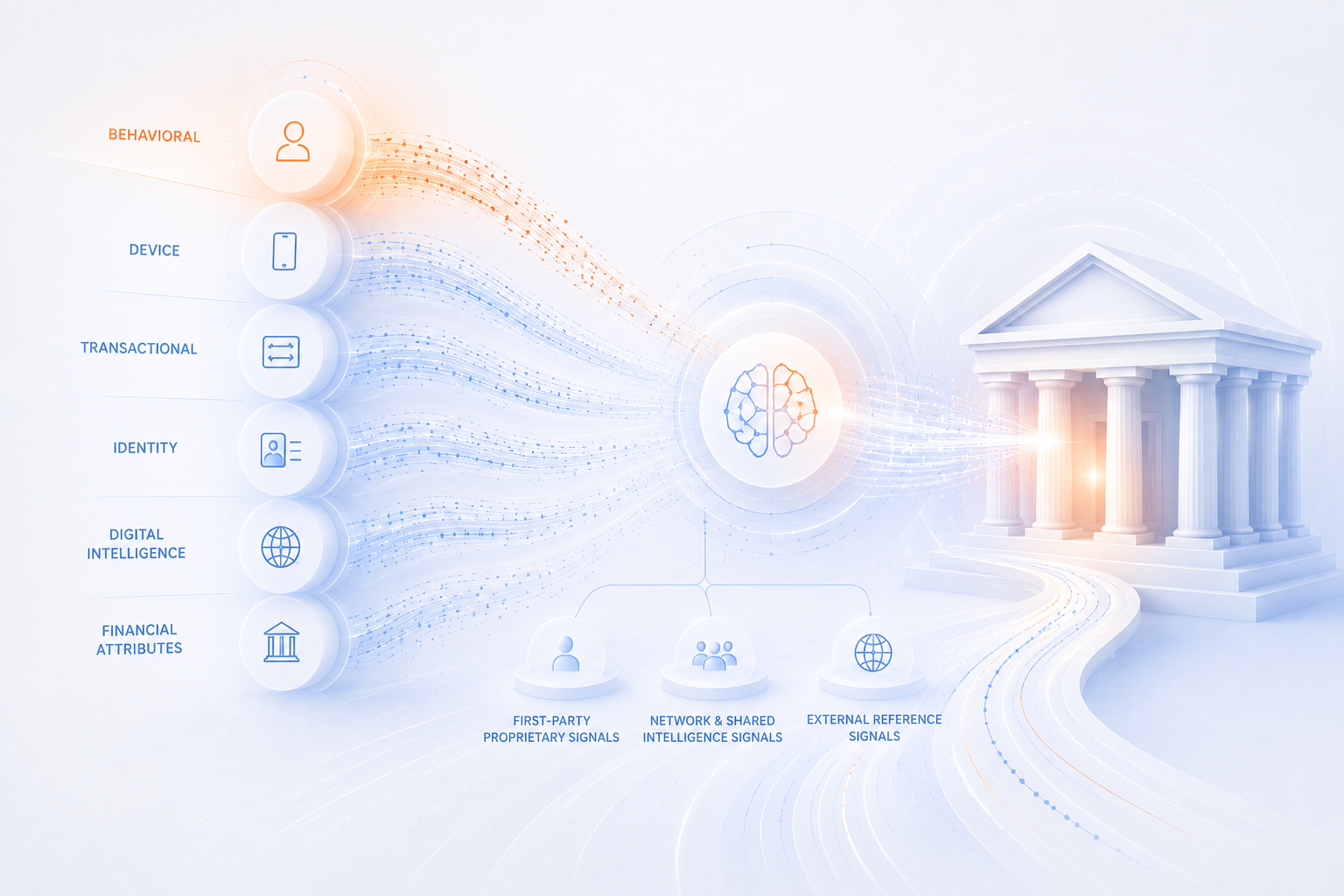
IDC’s research defines fraud stacks able to recognize user intent as those successfully integrating six signal layers: behavioral, device, transactional, identity, digital intelligence, and financial attributes. Crucially, IDC research shows, in today’s threat landscape, not all six layers are created equal.
Today, AI-powered fraud creates synthetic identities that pass identity verification, deepfakes defeat document-based checks, and credential stuffing and social engineering transpire within legitimate, authenticated sessions where transactional patterns appear normal. Bad actors manipulate and coerce genuine account holders into making payments that, to banks deploying legacy defenses, appear as normal, legitimate transactions.
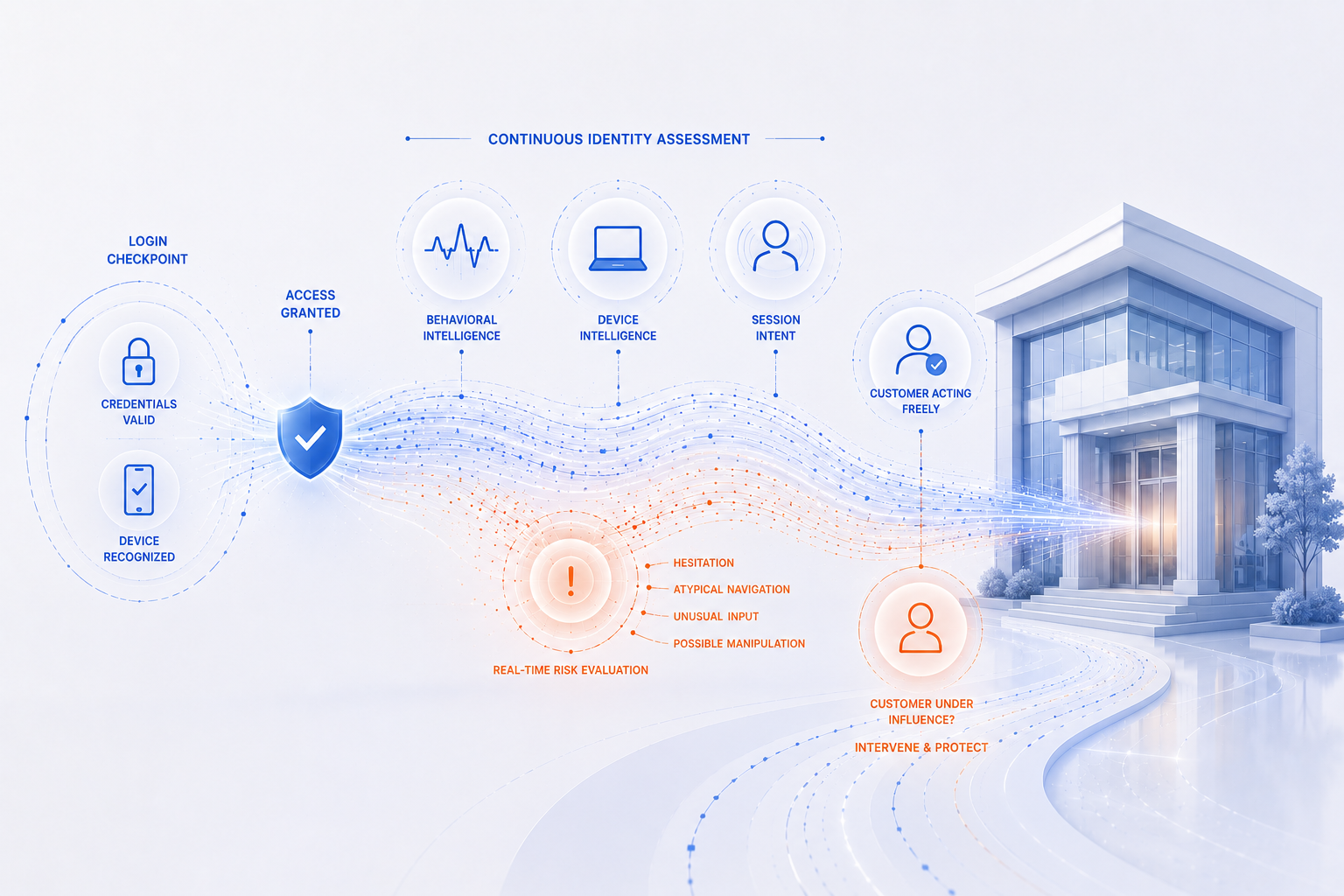
Only the behavioral layer can reveal signs of coercion in real time, capturing the ways in which individual users type, how they navigate, where they hesitate, and the physiological and cognitive patterns unique to each genuine account holder. At network scale — calibrated across billions of sessions across hundreds of institutions — all of these micro-signals form the one layer that:
- AI cannot yet replicate at scale: AI can generate convincing credentials and documents. It struggles to replicate the physiological and cognitive variability of genuine human interaction across millions of unique individuals.
- Most accurately and consistently detects modern scams: Social engineering scams involve a legitimate customer, on their own device, making a payment they’ve been manipulated into authorizing. The transaction looks normal, the credentials are valid, the device is recognized, but the user’s behavior reveals signs of coercion.
- Is hardest to fake without consortium-level calibration: A behavioral signal derived from a single institution’s data is useful. A behavioral signal calibrated across billions of sessions across hundreds of financial institutions is qualitatively different. It has been tested against a wide selection of fraud typologies few single institutions consistently encounter.
The fragmentation problem
Most institutions contract with three to five different vendors to build out their financial crime stack. Each vendor handles one layer. Those layers are integrated, but only loosely so, giving the bank broad coverage but shallow depth in the layer that matters most: behavioral intelligence.
Most banks have transactional monitoring but lack behavioral context. They have identity verification but lack insight into whether that identity is being manipulated during the session. They have device fingerprinting but lack understanding of how the person behind the device is actually interacting with it.
Solving this fragmentation problem requires a fundamentally different architecture of the institution’s financial crime stack. Behavioral intelligence can’t be bolted on as an afterthought to a transactional monitoring program. The data engineering, model complexity, and calibration requirements all differ too drastically.
The architecture that works
IDC’s framework identifies three categories of signal origin that matter just as much signal type.
- First-party proprietary signals come from an institution’s own customer history and transaction records. These are highly calibrated to an individual bank’s customer population but limited in breadth because institutional data alone cannot reveal fraud typologies that institution hasn’t yet encountered.
- Network and shared intelligence signals come from data aggregated across multiple participating institutions — a consortium model where members contribute data in exchange for access to pooled intelligence calibrated across the full network. This provides breadth no single institution can replicate.
- External reference signals come from authoritative third-party datasets: sanctions databases, PEP lists, credit scores, IP reputation registries, breach feeds, etc. This provides global industry context to the intel delivered by the two signals above.
A recognition-oriented architecture combines all three categories of signal origin across all six signal types, but the behavioral layer is where those signals originating at the network level can have the greatest impact. A behavioral signal derived from a single institution cannot compete with one derived from a global consortium of banks.
What this means for your institution
The operational reality is financial institutions need a specialist in the layer that matters most. A single vendor that claims to handle all six layers either lacks depth of vision in all of them or is overextending across domains where it has no expertise. To compete in the threat environment of today and tomorrow, financial institutions require a behavioral intelligence provider that:
- Provides analysis across a consortium network of banks and not just a single institution’s data
- Has been calibrated across billions and not just millions of sessions
- Recognizes user intent across account opening, account takeover, scams, and mule accounts
- Integrates seamlessly alongside other signal layers instead of replacing them
That’s the architecture both that IDC recommends and that consistently and persistently captures user intent in real time.
—
Key takeaways:
- IDC identifies behavioral intelligence as the most critical signal layer for detecting modern financial crime because it captures user intent that other security controls cannot.
- AI can defeat identity checks, documents, and credentials, but it still cannot reliably replicate the physiological and cognitive patterns reflected in genuine human behavior at scale.
- Behavioral intelligence detects social engineering scams in real time by identifying signs of coercion, even when the customer, device, and transaction all appear legitimate.
- Banks weaken their fraud defenses when behavioral intelligence remains fragmented or treated as an add-on instead of a core layer within the financial crime architecture.
- IDC recommends combining first-party, network, and external intelligence across six signal layers, with consortium-scale behavioral intelligence providing the greatest advantage.
- Financial institutions need a specialized behavioral intelligence provider that delivers continuous intent and identity recognition, operates at network scale, and complements every other signal layer in the fraud stack.
Resources:
- Blog: What is behavioral intelligence?
- IDC: Worldwide Banking Enterprise Risk Management and Compliance Technology Trends, 2026
- Blog: The Recognition Economy: A new framework for how banks will compete