
Para ler este blog em português, clique aqui.
One of Brazil's most important public safety publications, the 2026 Brazilian Public Security Yearbook, cited data from BioCatch's 2026 Digital Banking Fraud Trends in Latin America report this year to help explain how organized crime is evolving.
For someone who has spent nearly two decades working in fraud prevention, seeing our research referenced was rewarding. But the citation itself matters less than what it represents. The behavioral data banks collect every day is no longer only helping financial institutions stop scams. It’s becoming an important source of insight into how crime itself is changing.
For years, fraud was treated primarily as a banking problem. Banks were expected to prevent unauthorized transactions, reimburse victims, and strengthen their security controls. But the Yearbook makes a compelling case that this perspective is no longer enough.
As scams become more organized and interconnected, fraud has become a public safety issue that no single institution can solve alone.
Property crime has moved into the digital world
The Yearbook highlights how the nature of property crime in Brazil is changing.
As several categories of robbery declined, fraud has become Brazil's leading form of property crime. In 2025, Brazil recorded 2,261,055 fraud cases, an average of 258 every hour. Since 2018, reported fraud has increased by nearly 430%.
That doesn't mean traditional crime has disappeared. Instead, an increasing share of criminal activity has migrated into the digital economy, where it is often more scalable, more profitable, and less risky.
In my view, criminals have recognized a relatively obvious logic: A physical robbery reaches relatively few victims and exposes the offender to immediate risk, but a digital scam can target thousands of people across multiple states and financial institutions without the criminal ever meeting the victim.
The question, then, is: What do those digital attacks look like today?
Fraudsters adapted. So must fraud prevention.
The Yearbook references BioCatch data to help explain how fraud is evolving across Latin America. Regionally, in 2025, our research found:
- Fraud became Brazil's leading form of property crime in 2025, with more than 2.26 million reported cases.
- Criminals are increasingly manipulating legitimate customers rather than simply stealing credentials.
- By the time a payment is made, much of the fraud has already occurred.
- No institution has all the information needed to stop modern scams. Effective prevention depends on behavioral intelligence, information sharing, and collaboration across the public and private sectors.
In Brazil, our customers reported an approximately 140% increase in impersonation scams and a roughly 340% increase in fraud involving stolen mobile devices.
The trends all point in the same direction. As banks make credential theft more difficult, fraudsters increasingly manipulate legitimate customers, compromise trusted devices, exploit stolen phones that already provide access to a victim’s digital identity, and combine multiple techniques within a single attack.
As security controls improve, criminals simply shift to the next weakest point in the attack chain.
Identity is no longer enough
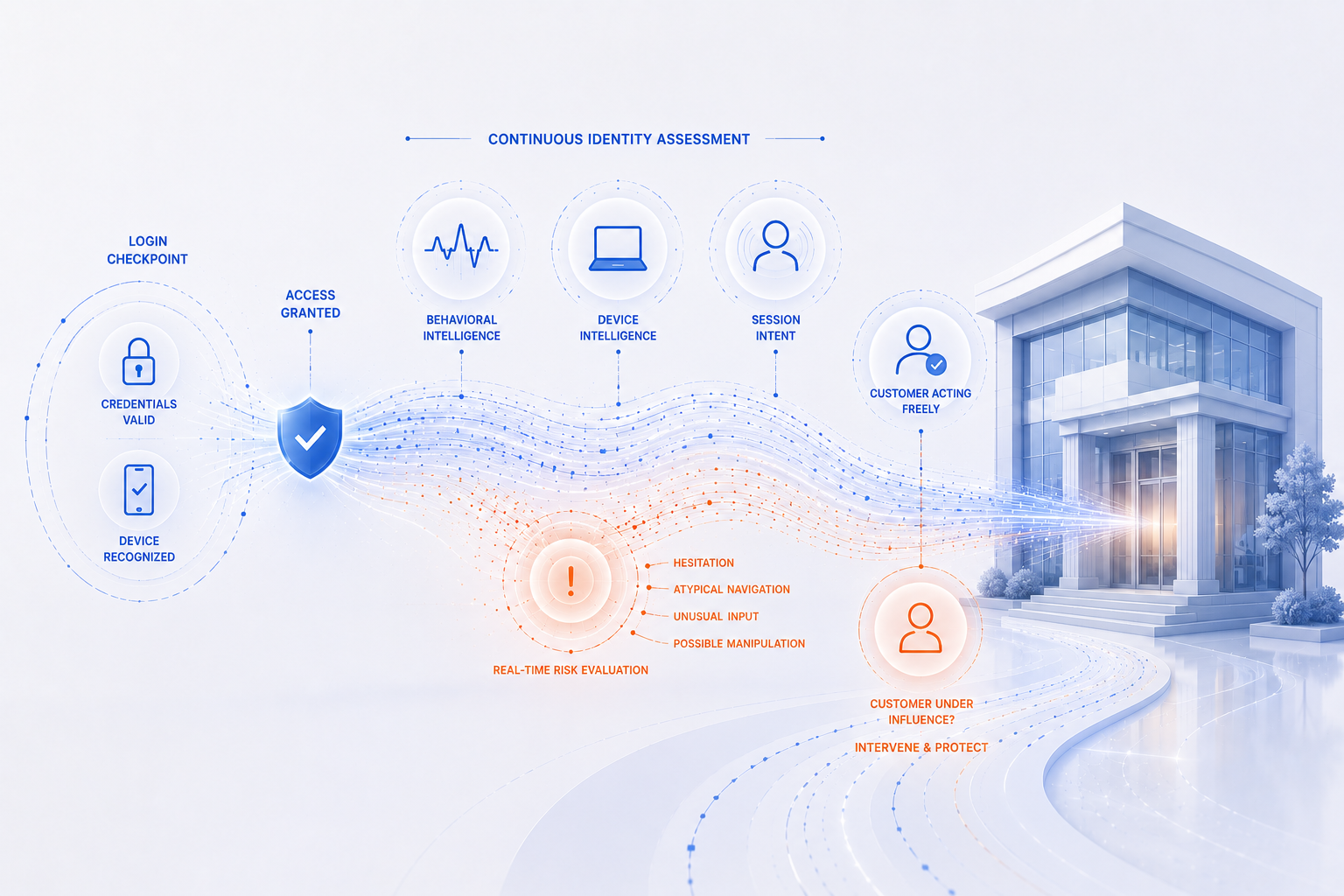
For years, fraud prevention centered on one question: Is this person really who they claim to be? That question remains essential, but today fraud teams increasingly must answer a second, far more difficult question: Even when this is the legitimate customer, are they acting of their own free will?
In many social engineering scams, victims authenticate using their own passwords, trusted devices, and legitimate credentials. Authentication succeeds exactly as designed. The problem is that someone else is influencing the session through a phone call, a WhatsApp conversation, or a remote access tool. The criminal doesn’t need to break into the bank. They simply persuade the legitimate customer to authorize the transaction.
This is why a so-called “Pix scam” rarely begins with Pix. The payment is simply the final step in an attack that may have started with a fake bank representative, a fraudulent advertisement, a fake website, malware, or a stolen device. By the time money moves, much of the fraud has already taken place.
No institution sees everything
That is also why one of the Yearbook’s most important conclusions is that awareness campaigns and tougher penalties, while necessary, cannot solve the problem on their own. Modern fraud rarely occurs within a single organization. It unfolds across an interconnected digital ecosystem.
The recipient institution sees the account receiving the funds. The telecommunications provider holds information about the mobile device and phone number. The digital platform may see the advertisement, fake profile, or message used to initiate the scam. Law enforcement agencies hold intelligence on investigations, criminal networks, and links between suspects.
Each organization holds an important piece of the puzzle, but very few can build the complete picture.
The Yearbook emphasizes that addressing scams requires national coordination, real-time operational integration, and shared responsibility across the ecosystem. To me, that is the report’s most important message.
Criminals already operate as connected networks. They share data, infrastructure, scripts, mule accounts, and tactics across organizations and jurisdictions. Fraud prevention, by comparison, still too often operates within institutional boundaries. No single bank, regardless of its size or sophistication, can stop a fraud scheme that moves across multiple organizations in seconds.
The opportunity lies in connecting signals that appear insignificant on their own. A change in customer behavior during a banking session, combined with a suspicious device, links to known criminal infrastructure, and intelligence shared across institutions, creates a far stronger picture than any one organization could assemble independently.
That’s what made the Yearbook's citation so significant to me. It wasn't simply that BioCatch's research appeared in one of Brazil's leading public safety publications. It was that fraud is now being viewed through a fundamentally different lens.
As scams become more organized and interconnected, protecting consumers will depend less on what any one institution can see and more on how effectively the entire ecosystem works together.
—
Key takeaways:
- Fraud became Brazil's leading form of property crime in 2025, with more than 2.26 million reported cases.
- Criminals are increasingly manipulating legitimate customers rather than simply stealing credentials.
- By the time a payment is made, much of the fraud has already occurred.
- No institution has all the information needed to stop modern scams. Effective prevention depends on behavioral intelligence, information sharing, and collaboration across the public and private sectors.
Resources:
- Report: 2026 Brazilian Public Security Yearbook
- Report: 2026 Digital Banking Fraud Trends in Latin America
- Blog: Taking it from the street: Brazil's criminal revolution
- Blog: New legislation raises stakes for mules in Brazil
- Report: 2025 Digital Banking Fraud Trends in Brazil